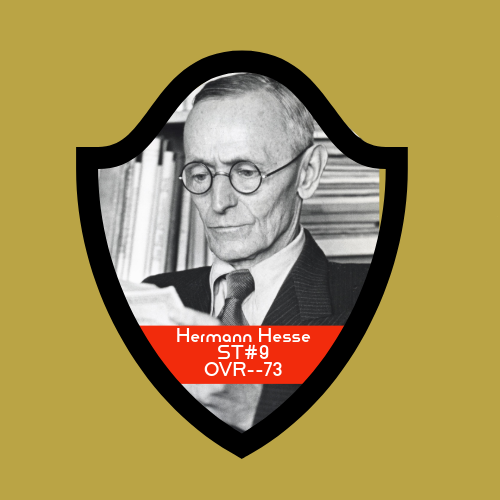
Hermann Hesse was born to a devout family in a small village nestled near Germany’s Black Forest. Thanks to his family emphasizing the role of art, literature, and music in nurturing strong discussions and faith, Hesse remained deeply immersed in intellectual pursuits. From an early age he was open to new ideas and different cultures. Ever the iconoclast, he celebrated becoming a father by leaving his young children to explore Sri Lanka and Indonesia. On his return, he enlisted to support for the German side in the First World War, by overtly encouraging understanding and compassion for the prisoners of war he served. He did all this through a carefully developed detachment from personal feelings in dealings with the world that drove others to strong emotional reactions. It might make him aloof and aggravating, but it was certainly a fixture in his view of the right way to live.
While he received the Nobel Prize shortly after the end of the Second World War, he really rose to prominence from the free spirited movement of the 1960s. The countercultural spirit and seeking of truth while releasing attachment spoke deeply to many, and soon young students came to agree with the old fuddy-duddies at the Swedish academy about “his inspired writings, which while growing in boldness and penetration, exemplify the classical humanitarian ideals and high qualities of style”
Works
“Nothing on earth is more disgusting, more contemptible than borders. They’re like cannons, like generals: as long as peace, loving kindness and peace go on, nobody pays any attention to them–but as soon as war and insanity appear, they become urgent and sacred”
“You should not take old people who are already dead so seriously. It does them injustice. We immortals do not like things to be taken seriously. We like joking. Seriousness young man is an accident of time. It consists, I don’t mind telling you in putting too high a value on time. I too, once put too high a value on time. For that reason, I wished to be 100 years old. In eternity however, there is no time you see. Eternity is a mere moment, just long enough for a joke.”
“What is called history at school, and all we learn by heart there about heroes and geniuses and great deeds and fine emotions, is all nothing but a swindle invented by the school masters for educational reasons to keep children occupied for a given number of years. It has always been so, and always will be. Time and the world, money and power belong to the small people and shallow people. To the rest, to real men belongs nothing, nothing but death.
–Steppenwolf (trans. Basil Creighton)
Message
Obviously, there’s a clear link between what Hesse would call radical detachment and what appealed so much to the counter-cultural cohort that adopted him as one of their own. But there’s never just one message, and from what I read, I think there’s one thing that Hesse is attached to: himself and being the fullest version of himself regardless of what others thought. So I would posit his primary theme as a belief that: the road to personal fulfillment is arduous and alienating, but also man’s highest calling.
Position: #9 Striker…with a caveat…
Hesse has some moments of staggering brilliance, individual quotes that can linger for a long time afterward, rather like a goal poacher who strikes and creates a memorable thrill in the crowd. BUT, most of the time people approach him as a genius, and I don’t. I see a rather self-important navel-gazer who has a better rep than he deserves.
To put this in soccer terms, I think of Hermann Hesse as a low budget Ruud van Nistlerooy. But, given the idolization of him, I think he’d probably end up miscast in the #10 role like Leo Messi–someone everyone expects to be a threat to score who can ALSO create amazing goals and support a team towards greatness…only…he never does.
I don’t think I’m a man for “Hot takes” either in sports or in literature, but this might be my hottest one. So let this fire up the comment section (please)
Next Time 1966 was a split prize year! So we’ll do a double in June! First we’ll look at Nelly Sachs!