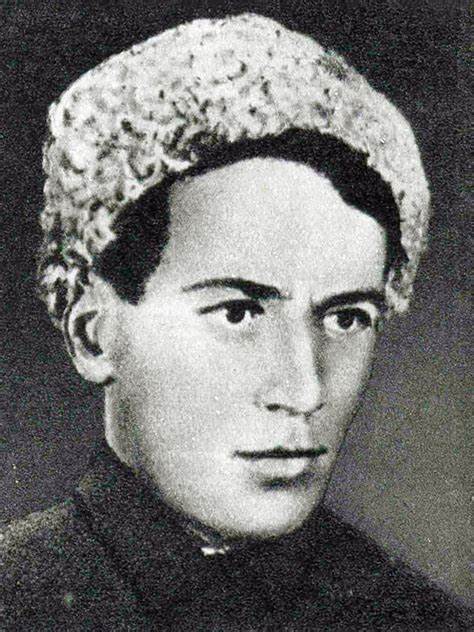
Mikhail Sholokov is another in the long line of Eastern European writers who I had never heard about before starting this project because, well, that’s how Western education rolls. Sholokov was born in a rural portion of Russia known as “the Don” after the local river. That was about all he seemed to need in life. He fought in the army, made powerful friends, but his life and his work eternally revolved around his humble farmland beginnings and everyone around him.
However, those powerful friends and patrons push him into a slightly different realm that he might have liked. One of Sholokov’s friends was Joseph Stalin (who made time for some light reading while organizing a despotic regime that murdered approximately 9 Million critics and opponents). Sholokov used his influence with old Joe to earn concessions for his community, justice for persecuted neighbors, and punishment for the corrupt (and in one case–defending the local XI from having their best player abducted by CSKA Moscow). However, he didn’t exactly kick up a fuss about the wider injustices (if it wasn’t in the Don, for Sholokov, it wasn’t on). It’s hard to tell whether his closeness with Stalin encouraged soviet government, newspapers and schools to lift him up to the position of a laureate, or if those who opposed Stalin kept him off of shelves and confined to a controversial corner where he was accused of plagiarism.
Either way, Sholokov won the 1965 Nobel Prize for giving “expression to a historic phase in the life of the Russian people” through his work Quiet Flows the Don.
Works
From “Family Man” a short story of a father who fought with the Tsar’s forces against his own sons who had left home to join the Soviets. In this scene, the father Mikishara narrates what happens when he finds his son as a prisoner of war among his own battalion.
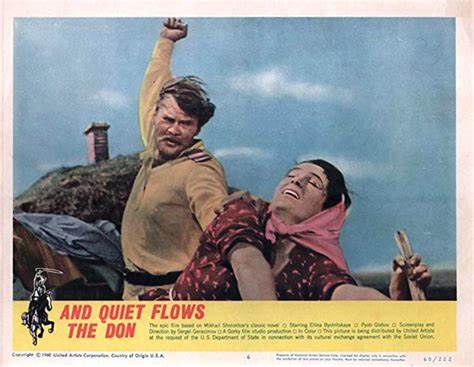
I did watch the movie…and as a former student said, “yeah, you didn’t miss much”
“The Cossacks roar with laughter.
” ‘Make them soak in their own blood Mikishara! It is obvious you’re taking pity on him, on your own Danilka. Strike him again or we’ll make your blood flow!’
“The captain came out on the porch; he was swearing but his eyes were laughing. When they began to slash them with their bayonets, my heart couldn’t bear it. I started running down the street. I looked back and saw them rolling my Danilushka on the ground. The sergeant stuck his bayonet in his throat but only Khrr came out”
Message
In both his work and his life, Sholokov’s devotion and dedication to Cossaks on the Don (both good and bad) brings to mind so many specifics that outsiders are left only to observe and ponder the culture. If I were to extrapolate that out into a message I might say “Live locally. It’s the immediate that matters.”
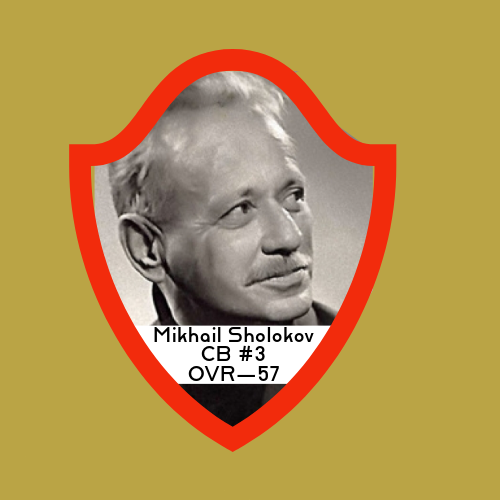
Position: #4 Center Back
There’s a lot in the plot of Quiet Flows the Don that reminds me of Tolstoy’s epics, albeit without the bourgeoise or occasional redeeming features of the protagonist. To be fair, I watched the 1957 adaptation rather than reading the book, but in small selections and a conversation with a former Russian student it sure seems to be an accurate adaptation of both tone and characters. With that Tolstoy-lite label and the uncertainty over his authorship or willingness to approve of Stalin’s worst traits, I’m left shrugging. Sholokov would clearly care about defending his territory, but he also seems like a player who has the unswerving allegiance of the coach without a whole lot of reason why.
So there you have it, an ultra HOT TAKE (about an author who has been dead for forty years). Feel free to challenge me in the comments below. (Also, I know that my numbers/colors aren’t matching for Sholokov…but until such time as someone tells me it matters, I’m going to show myself some grace and let it be)
Next Time, 1985 Honoree Claude Simon
Hooray a representative of Africa! And he’s…no…wait…white again.
From the Cervantes Library…this is either Mistral or Edith Piaf…?
Gabriela Mistral started out as a girl in the small Chilean village of Montegrande. Or rather, Lucia Godoy Alcayaga did. Lucia didn’t become Gabriela until afteer she turned 19 and began to publish regularly. She chose to take the pseudonym that honored her favorite poets: Gabrielle D’Anunzio and Frederic Mistral (HEY! We know him!)
Unsurprisingly, poetry didn’t pay the bills at first and she began a teaching career (so there’s hope for me to write one of these about myself yet). As a teacher Mistral ran across another young Chilean poet who will get his own entry in a few years: Pablo Neruda. When her renown as a poet grew, she left the classrooms and entered a variety of embassies all around the word. (Which was probably for hte best given Chile’s history of brutal dictatorships…distance was probably for the best).
Living the rest of her life as an exile, she did make good friends in a variety of literary circles until 1945 when she became the first Latin American to become a literature laureate “for her lyric poetry which, inspired by powerful emotions, has made her name a symbol of the idealistic aspirations of the entire Latin American world”.
Works
All selections taken from Mistral’s Madwomen collection–translated by Randall Couch
“When I walk all the things of the earth awaken, and they rise up and whisper and it’s their stories that they tell.
And the peoples who wander leave them for me on the road and I gather them where they’ve fallen in cocoons made of footprints
Stories run through my body, or purr in my lap. They buzz, boil, and bee-drone They come to me uncalled and don’t leave once told.”
—“The Storyteller”
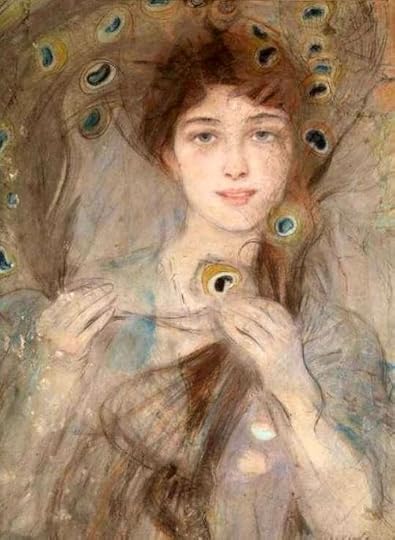
One artists interpretation of Madwomen poems
“In a whirlwind she would rule over meals and linens the winepress and beehives the minute, the hour and the day…
And wherever they went, all things voiced a wounded cry to her: crockery, latches, doors, as to their bellweather; and for her sister they grew hushed, spinning tears and Ave Maria”
–Martha and Mary
Message
In an evergreen theme, Mistral’s topic throughout her Madwomen’s poems seems to challenge the presumptions endemic to humanity. To all the men in government, academia, literature and life write large the women who would be named “the poet of motherhood” seems to say “there’s more complexity in our lives than you are ready to behold”
Position: #6 Defensive Midfield
Like thee friend she made on her diplomatic tour, WB Yeats, Mistral seems to have a split view of the craft. She keeps one foot in the past with her style, structure and symbolism, and another foot on the gas with novel and innovative themes and expressions. To my mind that makes her a good choice for a defensive midfielder. She’s absolutely valuable, but a little too stiff for my tastes.
Try as I might to read this in Spanish most of the ideas slipped through my fourth grade level understanding of the language. If you have a different point of view or would encourage me to read another translation, let me know in the comments below.
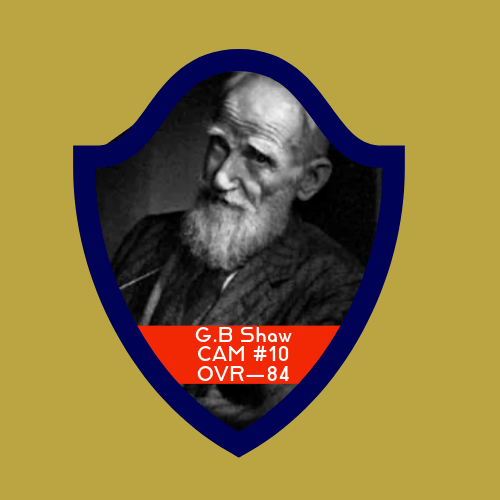
George Bernard Shaw is one of the true rarities in this project. A long and fruitful career writing, primarily, comedies! Despite his strength in the genre, his childhood was not a laugh riot. Shaw and his family dealt with numbing poverty and deep loss, but Shaw found a way to educate himself by lurking in museums and reading rooms in Dublin and then London before becoming a writer.
While his novels never gained a footing, his time as an art and drama critic gave him great insight into the revolution on the stage started by Henrik Ibsen in Norway. Soon, he was writing his own dramas and filling theaters in London. From there he began a long and storied career as a critic, wit, essayist, and thinker, capturing much of the old world and its conflict with the modern replacement
Works
Soldiering, my dear madam, is the coward’s art of attacking mercilessly when you are strong, and keeping out of harm’s way when you are weak.
–Arms and the Man
The worst sin towards our fellow creatures is not to hate them, but to be indifferent to them: that’s the essence of inhumanity.
—The Devil’s Disciple
Message
As someone who often felt a bit out of step with the educated and wealthy elites he joined, Shaw certainly had a pattern. In the works I read (slash listened to thanks to great series of plays from LA Theater works), and those I know from years of being a nerd, Shaw loves a story where a privileged few see their world and sense of self upended by an outsider: the enemy soldier in Arms and the Man; the prodigal son in The Devil’s Disciple; the cockney flower girl who rises in society in Pygmalion (or its more famous adaptation: My Fair Lady); or, my favorite example, the Polish daredevil who literally crash lands in an English greenhouse (Misalliance). In all these, his overarching theme seems to be outsiders often understand our communities better than we do.
Like his fellow playwright, big thinker, and questionable human, Jean-Paul Sartre, I would slot Shaw as a #10 creative attacking midfielder. Naturally, dramatists have a tendency to control all the action and make suggestions for everything that happens in the story (even if living people bring it to life). Shaw also checks boxes as a creative and crowd pleasing talent, even if he does have some pretty clear tendancies and habits. Clearly, Shaw gets aggressive in how he skewers the rich and powerful, a style born out in his preferred sport (not soccer but boxing).
To be frank, I rated Shaw’s strength in midfield before I found out about his political…uh…jackassery. But I think the ranking holds as his work as a writer undercuts his own views (rather than amplifying his worst opinions…looking at you Wladyslaw Reymont).
If you’d like to dispute this, my standing offer to join the conversation stands. Comment below if Shaw should step up to the top of the midfielder rankings or slide more than I considered.
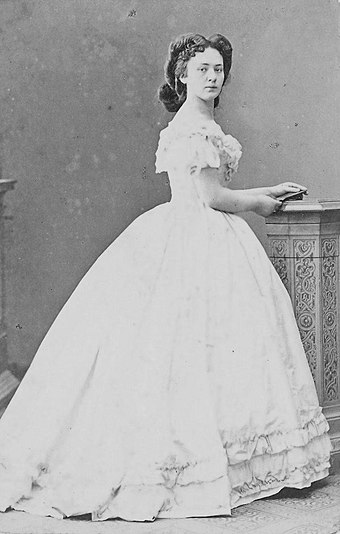
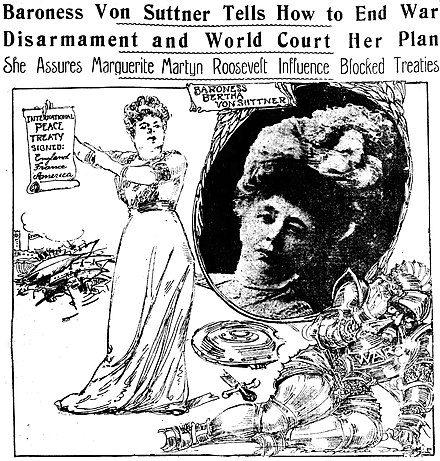
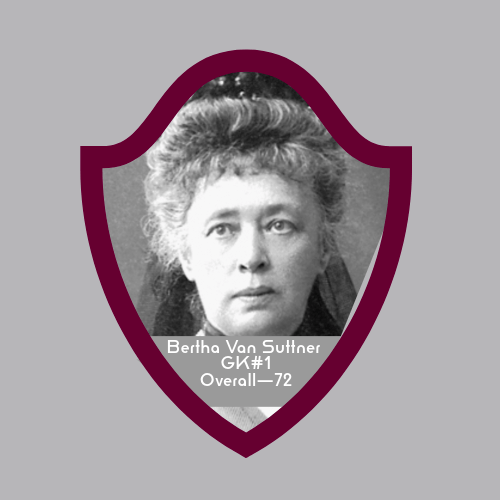
Bertha Von Suttner was the first woman to be awarded the Nobel Peace Prize. While she was broadly active in the peace movement (especially for a woman in the 19th century), the Nobel website specifically cites her book Lay Down Your Arms as a major factor in winning her the award. With that in mind I chose to add her to the Nobel FC roster. If you don’t like that…please write something…I’m afraid I’m a nutcase creating a truly bizarre alternate reality of soccer and books.
Anyway…back to Bertha. She grew up in Austria as the daughter of soldiers and nobility, which accounts for her liberty to read, write, and travel as a woman of leisure. However, she ultimately entered the workforce as a governess/tutor to another Austrian family with a long military pedigree. She later was briefly the secretary for Alfred Nobel, you know, they guy who founded all these prizes. She ultimately eloped with the son of her tutoring family (before you ask, no, this was not a Lifetime movie, he was never her tutee and was 23 when they met). And they lived apart from the family making ends meet through tutoring and freelance writing.
Eventually reunited with their Austrian family, Bertha found new work in advocating for peace. As the popularity of her other writing grew Bertha was invited to speak more frequently and when she published the novel that played a major part in winning the peace prize: Lay Down Your Arms which became a bit of a cultural craze in 1890s Europe. Bertha, who had already been active in the peace movement, became a leading figure (one called her The Generalissimo of Peace). She also travelled broadly in support of Women’s Rights (including speaking at a conference organized by a group that employed my favorite peace advocate…future Montana Congress Woman Jeanette Rankin)
Works
“Your ‘yes’ [vote for war] will rob that mother of her only child. Yours will put that poor fellow’s eyes out. Yours will set fire to a collection of books which cannot be replaced. Yours will dash out the brains of a poet who would have been the glory of his country. But you have all voted ‘yes’ to this, just in order not to appear cowards, as if the only thing one had to fear in giving assent was what regards onesself“ —Lay Down Your Arms
“The village is ours–no it is the enemy’s–now ours again–and yet once more the enemy’s; but it is no longer a village, but a smoking mass of the ruins of houses” —Lay Down Your Arms
Message
Obviously, as a pacifist and an activist, Bertha had a clear moral she wanted to communicate to the masses. She also has a tendency to hammer on the same point and demolish the same straw men arguments with the fervor of a scarecrow demolition crew. Still, within her context it’s really worth considering Bertha’s specific position that expanded the peace debate, namely: war and violence spread destruction far beyond the battlefield. That seemingly simple fact is often ignored by those who valorize battle.
Position: #1 Goalkeeper
Bertha can easily be minimized as just a pacifist, but she does her very best to broaden her position and stands her ground against a much more aggressive opponent. To me, that’s a great synopsis of a goalkeeper’s duty. Her most acclaimed novel covers a lot of ground and refuses to let other opinions just slide by, so I’m going to put her between the posts and let her do her thing. (I’m also going to continue my Jeanette Rankin shoutouts by putting her in the Garnet and Silver of Montana…and I fully expect the Griz staff could make even a 180 year old Baroness an effective shot-stopper.)
So there’s a big shout out to Bertha, if you prefer her poetry or insist that she be moved to the attack, let me know in the comments below. Come on…for my sanity at least.
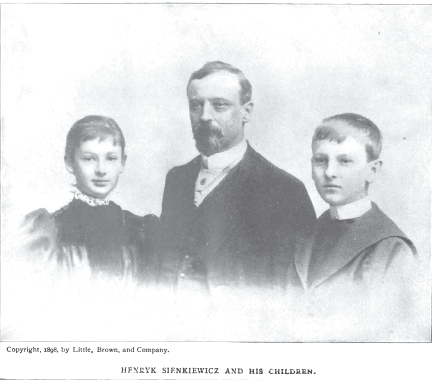
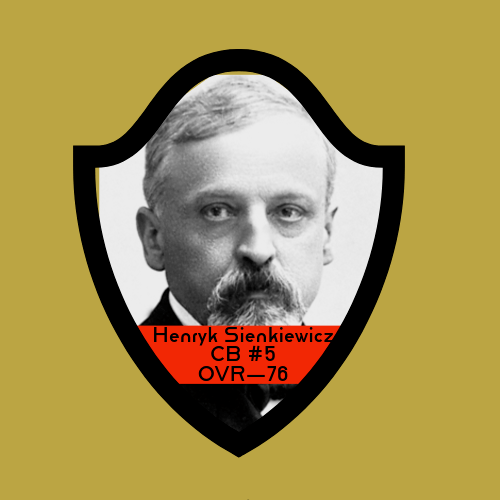
Henryk Sienkewicz grew up within a revolutionary family in Poland in the middle of the 19th Century, and learned how to match his father’s political beliefs with his mother’s passion for history. He spent a lot of time in the library, but this curiosity did not translate to a love of school. He left college early to write full time. After successful short stories, he started writing about his experience traveling the world (including into the United States, a rarity for the time).
After returning to Poland and starting a family, he started writing full length novels including a historical trilogy about life in Poland a hundred years before (creatively titled: The Trilogy), but his most popular and enduring work came ten years before his Nobel with the book Quo Vadis. His talents were so impressive, that he won the Nobel for, simply put “his outstanding merits as an epic writer”. As if that wasn’t enough, the people in Poland took up a collection to buy his family’s old castle for him.
Works
““It seemed that out of every tear of a martyr new confessors were born, and that every groan on the arena found an echo in thousands of breasts. Caesar was swimming in blood, Rome and the whole pagan world was mad.” —Quo Vadis (all of these are from Quo Vadis)
“Why does crime, even when as powerful as Cæsar, and assured of being beyond punishment, strive always for the appearances of truth, justice, and virtue? Why does it take the trouble?” —Insert trenchant current event observation here
“For when a man is in a book-shop, curiosity seizes him to look here and there.” —This may also serve as my life’s motto
“A home without a book is darker than one without a lamp.”
Message
Having read that most popular novel, one that captures the conflict between a brutal Roman Empire and the fledging Christian church, I was shocked at how much a 130 year old Polish man captured my sense of faith. Above all, faith requires just that: faith. There has never been and never will be an easy answer for those confronting the conflict between ideals and life. Simply appreciating that struggle both around and inside you is worthwhile.
Position: #5 Center Back
Sienkewicz is probably my favorite century old writer that I’ve come across, and while his books really are epic sized, his style is wonderfully simple and direct, with just the expected touch of violence. As such, he seems to me like a no-nonsense, efficient defender, and one who could be mature and kind hearted enough to be team captain like Michael Boxall is.
Here’s my traditional request for you to engage with this blog beyond clicking the like button. Have you read the author? Do you love soccer? Any and all comments welcomed!
Next Time: Special Bonus Laureate!! 1905 Peace Honoree Bertha Von Suttner
(The only non literature laureate who was given their award specifically for writing a book)
The time has come again, to crown this year’s winner of the MacKenzie Cup (it’s a sippy cup…because it started when you were little kids, and I still like the joke)
Final Standings
Team
W
D
L
PPG
GFA
GAA
Montana
12
5
2
2.16
1.53
0.53
Minnesota
26
10
15
1.73
2.33
1.25
Rosenborg
37
7
25
1.71
1.68
1.16
Grenoble
26
10
22
1.52
1.60
1.12
Emelec
17
13
13
1.49
1.21
0.93
Punjab
13
5
12
1.47
1.67
1.77
Freiburg
25
15
27
1.34
1.49
1.70
Ross County
13
10
20
1.140
1.30
2.00
Legon Cities
12
5
19
1.139
0.89
1.11
Vozdovac
13
11
21
1.11
1.04
1.18
Alebrijes
6
8
14
0.93
1.04
1.93
Table Updated 12/30/24
You can read all about the end of the campaign and some general thoughts in the December recap post.
While the Griz walked away with a regular season title, and las Electricas of Emelec won their tournament and a promotion to the top tier of women’s soccer in Ecuador, several usually strong sides came back down to earth a bit. The Rosenborg Kvinner underwent a lousy end of their campaign to finish lower than they have since we started. Minnesota Aurora were knocked out earlier in the playoffs than ever before. Grenoble, Punjab, and Freiburg all went from table topping to solidly mid-table.
Hardest to watch were the teams that struggled the most. Emelec’s men side finishing last in the league, Alebrijes and Legon Cities suffering long losing streaks. And Vozdovac got demoted out of the top flight in Serbia.
Players of the Year
The best XI of the year features four returning starters. Vincenzo Grifo is fully on the road to being enshrined in the hall of fame of our minds, and for the second year in a row, Cat Rapp joins him in the midfield. Luka Macjen’s love of playing in Punjab could put him in the same spot in a few years, and Mathys Touraine was again the best corner back of the year (though his moving on to Paris may reopen a spot for Jessy Benet to return to the squad full time).
Newer players may not be here for long, The Griz are limited by graduation limits, so Charley Boone is done after this. Froya Dorsin is already off for Paris and Sverre Nypan Halseth may be in any number of bigger profile stadia within the next month or two. Likewise it’s hard to see struggling teams like Legon and Ross County hold on to strong defenders like Frank Akoto and Ryan Leak. But Kerly Corozo becomes the first Electricas player to crack the starting XI and may find a spot on the wing for many years to come.
The bench includes Alison Ochoa as another representative of las Electricas and Claudia Fabre from Grenoble hopefully creating a Charley’s Angels trio with Luka playing Bosworth. (Yes I’m making 50 year old pop culture references despite the fact that I’m only 40…) Minnesota adds in two more midfielders with Mariah Nguyen and Bongi alongside the Freiburg Frauen and defensive midfielder Samantha Steuerwald. Our Defensive bench is made up of the best of the bad lot with cellar dwelling Emelec, Oaxaca and Vozdovac each offering one body…but Dayne St. Clair should be able to handle them.
Nobel FC Most Enjoyable Outstanding Writer
The MEOW, as befits our cat-crazed house, goes to this year’s highest rated Nobel FC subject: Jean Paul Sartre. I do feel that I should note that Jaroslav Seifert and Han Kang were surprising treats. But Sartre’s vision and imagination (plus raging ego) gave him the highest rating so far (a number matched in video games by this year’s FIFA Player of the Year: Vinicius Jr.)
What’s Next
I will continue to ask people to comment, and they will continue to ignore me.
But hopefully in the coming year, I’ll be able to give more voice to my sons so that this truly becomes a space for all the MacKenzie Boys and not just me.
Quick Points Update: Han Kang was not on any of my lists for this years Nobel FC Draft. But She still gets the full star treatment here.
Background
Winner Han Kang as a young girl (2nd from left, not making wild face) From Kang’s Father (Han Seung-Wong far Left) and reprinted in the Korean Times
Han Kang was born in a literary family in the Korean city of Gwangju to a family that survived several traumatic childbearing experiences. That difficult experience that marked her context before birth appears throughout her writing.
So too does a love of literature as her father is both a novelist and a professor. Kang has said she grew up thinking of books as though they were “half-living beings” and to read her work is to see the ideas grow and develop and carry with them tragedy and hope in one fell swoop. (Likewise her hometown became the site of a brutal attack by a dictator against pro-democracy activists creating another trauma to grow through.) Growing up with migrane headaches, she was not very physically active, and so she built a long standing love of reading and literature.
Kang’s first work was published as poetry, though she grew into more complex and frequently meditative literature which focused on ideas, feelings, and impressions rather than plot. When she was awarded the Nobel Prize (“for her intense poetic prose that confronts historical traumas and exposes the fragility of human life”) she quickly became one of the youngest people to ever win as well as the first Asian woman.
Works
Swaddling Bands, white as snow are wound around the newborn baby. The womb will have been such a snug fit, so the nurse binds the body tight, to mitigate the shock of its abrupt projection into limitlessness.
Person who begins only now to breathe, a first filling-up of the lungs. Person who does not know who they are, where they are, what has just begun. The most helpless of all young animals, more defenceless even than a newborn chick.
The woman, pale from blood loss, looks at the crying child. Flustered, she takes its swaddled self into her arms. Person to whom the cure of this crying is yet unknown. Who has been, until mere moments ago, in the throes of such astonishing agony. Unexpectedly, the child quiets itself. It will be because of some smell. Or that the two are still connected. Two black unseeing eyes are turned towards the woman’s face – drawn in the direction of her voice. Not knowing what has been set in motion, these two are still connected. In silence shot through with the smell of blood. When what lies between bodies is the white of swaddling bands.
–“Swaddling Bands” The White Book
“The feeling that she had never really lived in this world caught her by surprise. It was a fact. She had never lived. Even as a child, as far back as she could remember, she had done nothing but endure.”
—The Vegetarian
Message
Far be it from me to read two stories and claim to be an expert…except that’s exactly the premise of these posts. If I were to name a theme in Kang’s work it would be that pain has a beauty all its own and pushes us to question what we fear. In both The Vegetarian and The White Book she explores the nature of human endurance and suffering and yet remains open to and appreciative of it in a way that confounds rigid societal expectations around her and her genre of the moment. The Nobel emphasized that trauma and fragility and to me this is very much akin to that notion, but far more appreciative and less dour.
Position: #8 Midfielder
For the second straight year the Swedish Academy opted to go with a stream of conscious adjacent writer. And just like with Jan Fosse last year, I’m declaring that good enough for me to see Han Kang as a box to box midfielder, capable of both a cutting pass and a crunching tackle. She also gets bonus points from me to move her ahead of Fosse in the Starting XI because she was more comprehensible than Fosse was.
I really liked Han Kang, but I really didn’t like the delay that held me back from finishing this post for two months. Still, here it is and you can argue with me below.
Next Time (Rewind the Clocks, it’s time to start on the ’05s) 1905 Honoree–Henryk Sienkewicz
In just a few days, the Nobel committee will announce the winner of the 2024 Nobel Prize for Literature. Just like last year, they will join an elite group of writers from around the world, and a small selection of those writers who we have read, reviewed, and classified as members of Nobel FC: The only Fantasy Football team where the Fantasy is that these people would ever play.
I’ll try to read the author in question as soon as I can, and write their post by the beginning of November, but I wanted to take a moment for the second year in a row to consider who will be joining this august group.
How does the “draft” work
First a recap for those who somehow found this website but are unfamiliar with both “drafts” and “The Nobel Prize” (just how deep an internet rabbit hole have you gone down, my dudes and dudettes?)
In American professional sports there are annual “drafts” where teams select from a collection of players not yet in the league. Teams study and examine player abilities, debate the best choice, and then “draft” someone to become a part of their organization.
The Nobel Prize is a little like that. The “Team” in question is the Swedish Academy (of Literature). They collection of players not yet in the league is literally everyone on earth, who has yet to be awarded the Nobel, is living, and who wrote something. (Literally, they have awarded a prime minister for stirring speech writing, and a folk singer for his lyrics.)
That’s a big field, so they take in nominations from other Academies of Literature around the world, professors of universities, living laureates, and presidents of Authors’ guilds. That is still a very big field so they narrow it down to five finalists: study and examine the writers abilities, debate the best choice and then “award” someone the Prize.
This process has been a little controversial over the years. After all, why do the Swedes get the final vote? (Alfred Nobel said so) Does the fact that the Swedish Academy is mostly old, white, male, Europeans explain the fact that most of the laureates in history have been old, white, male Europeans? (Yes) Will they try to be more inclusive in the future? (Yes, though they kind of had to after a pretty ugly scandal).
So Who Could be “Drafted” This Year?
We don’t know the top 5 candidates, or even the top 100 candidates who got nominated, and we won’t for another 50 years (long after the internet, including this post becomes a time capsule for aliens). But we have a list of likely candidates from gamblers and prognosticators. (I’ll toss out 11 here)
Last year’s 11 now off the list:
Jon Fosse won last year’s award, making him only the fourth Norwegian to win (tell me there’s no bad blood between the nordics…I bet the Swedish academy is just bitter about having soggy krumkake). While Fosse won a place in history books (or at least an extra line on Wikipedia), I won two nonsense points. My goal is to hit 11 points with 5 points if I correctly predict either on the *will win* or should win; 2 points if they’re on either “honorable mentions” list, and 1 if they’re in my 11 top candidates).
None of my other candidates lost their eligibility due to the unfortunate state of being dead…but I have decided to drop Frenchman Pierre Michon as he has slipped behind other French writer Helene Cisoux and the French have already had a major cultural moment this year with the Olympics as well as a recent laureate, I’m putting both Michon and Cisoux towards the middle of the queue, just outside this list.
Leading Candidates:
The leading favorites are Can Xue, a Chinese author who frequently challenges the increasingly authoritarian establishment in Beijing. Her style has some parallels with other challenging stream of conscious writers like Elfriede Jelinek and John Fosse, and while the committee likes to hit similar styles she would offer a distinct cultural and linguistic perspective, especially given the absence of awards to Asia in the last 10 years. There’s also been a surge of popular sentiment around Syrian poet Adonis who is often on these lists, and would represent a first winner from the arab world since 1988, while also drawing attention the ongoing issues in Israel with both Palestine and Lebanon. Lyudmila Ulitskaya is another political context pick who was briefly atop the rankings this year given her position as a strident opponent of Vladmir Poo-head (sorry, that’s Alex’s name for him). But she has slipped as well, particularly as the unrest in Israel grows.
Returning Candidates:
Then there are the popular picks, like Haruki Murakami, who has a wide following in seemingly every country on earth. However, given that the Nobel likes writers who court a little political controversy, Murakami seems less likely than Xue. The same could be said of other popular writers from often awarded regions and languages like: American Thomas Pynchon, Global Indian/Brit/American Salman Rushdie, Canadian Anne Carson and Australian Gerald Murnane. The Academy has seemed to be breaking apart from its old habit of just cycling through the West’s biggest culture factories, but that doesn’t change the fact that these broadly appealing writers are perennially near the top of the betting odds and in wide circulation at the Swedish library.
If they wanted to award a Western literary heavyweight but NOT someone who writes in a frequently awarded language, then they could consider Romanian novelist Mircea Cartarescu. Caratescu just won the Dublin Literary award (which represents the biggest financial prize for one book rather than a series). But as there’s no real link between awards and the Nobels seem to see themselves as separate entities, it may not work. Since they went to this well with Fosse last year, I’d put this as the least likely candidate.
Beyond Europe and Asia, the oddsmakers and the pundits don’t have many options. Perennial contender Ngui wa Thiong’o of Kenya looks to represent Subsaharan Africa and at 84 may be running out of time, while Mexican poet Homero Aridjis is a widely appreciated poet from Latin America (an area of the world not awarded since 2010), odds makers have him running behind Argentine poet (Cesar Aira), but with a limit of 11 picks, and several pundits pointing out Aridjis popularity among committee members for the last few years, I opted to keep Aridjis on the list. Like Cartarescu he also is coming off a prize win for the Griffin Poetry Prize from Canada (though that was more about his translator George McWhirter than an award for himself).
Analysis: Who will it be? Who should it be?
In articles analysing a team’s draft-day decisions, writers look at two things. What they think the team leaders will do, and what the author themselves would do if they had a chance.
Having already read books by Murakami and Rushdie as well as selections from the other returners, I read a few well-recommended lines from my two new names (Adonis and Ulitskaya) and came with the following suggestions.
The Academy Will Pick
The Swedish Academy tends not to prioritize the best selling or most widely acclaimed author available, they prefer those who have something artistic to offer in their work and especially if they have something beyond the purely personal to uncover. At times that leads them to revel in awarding obscure writers, and in the last four years, awarding more diverse picks, with a significant increase in female laureates.
So I think they will pick: Can Xue. I only read very brief excerpts from her work…but even that seemed weird and obtuse. Critics claim her work is often plotless, but that’s not a negative in the hands of the Nobel Committee, in fact it makes a nice counterpoint to Jon Fosse’s more linear stream of conscious win from last year and an echo of Elfreide Jelinek. She’s got art, she’s got style, she’s got a point of view. She’s the favorite for a reason.
If left up to me, I would try to award a writer from outside the common-sphere of Nobel winners (ie Western Europe/America and white men). A more diverse writer with a point of view that connects to the wider world would be the ideal for me. Artistry is something I think lies in the eye of the beholder, so better to be clear than artful in my eyes.
While I liked what I read from this year’s new comers, I don’t see enough reason to step away from my same pick last year: Homero Aridjis. Admittedly, I only looked at four of his poems, but he evokes a universality similar to Paz and Neruda, while also considering the broader scope of history and nature–which might suit the climate change conscious Academy/myself to boot.
Honorable Mentions: Ludmilia Ulitskaya, Salman Rushdie (I still think of him as an Indian writer despite his increasingly American identity)–BONUS: I’m going to keep pushing Louise Erdrich out of stubborn loyalty.
Who would you pick?
Leave a comment below, please, even alien overlords, comment with your pick.
UPDATE!
Next Time…I rush to judgement on whomever our winner isSouth Korean writer, and youngest Nobelist in 37 years…Han Kang
Nonsense Point total: 2/11
I was nowhere near Han Kang in all these names, so zero points to me…next year should see a massive drop in chances for Xue and Murakami though, so it’s going to be different for sure
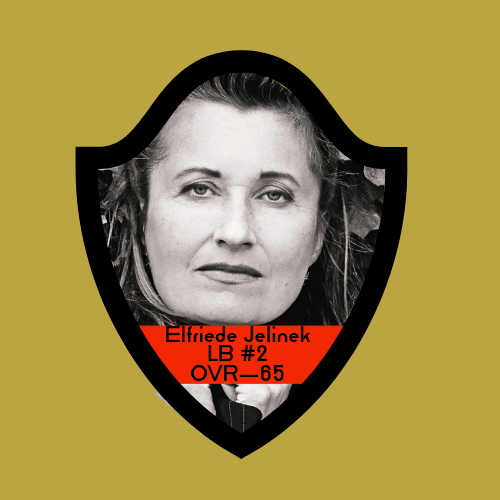
Elfriede Jelinek is the first female writer we’ve covered in our Nobel Laureate reread project, and she is a truly distinctive voice in contrast to what else we’ve read in this project.
Jelinek was born in Austria shortly after the fall of the third reich but with a family that connected both to Austrian high society and Czechoslovakian Jewish community. She began her writing career as a poet before moving into fiction and then drama, all the while maintaining frequent poetic interludes that border on free verse stream of consciousness (the kind that is…challenging to parse). While she has long been widely appreciated in German literature, but less widely known in translation. She was taken aback by being given the Nobel in 2004: “for her musical flow of voices and counter-voices in novels and plays that with extraordinary linguistic zeal reveal the absurdity of society’s clichés and their subjugating power”. She was not alone as one member of the Swedish academy resigned following her prize calling her work: “whining, unenjoyable public pornography”, and “a mass of text shovelled together without artistic structure”. She’s also had a documentary that calls her a “linguistic terrorist”.
Jelinek still writes, but as someone who struggles with agoraphobia and paranoia, she did not accept the award in person (like Jean Paul Sartre 40 years before).
Works
“Erika distrusts young girls; she tries to gauge their clothing and physical dimensions, hoping to ridicule them”–The Piano Teacher
“We made these nothings [athletes] into greats, into disturbers. Into heavyweights. We commoners, we who can never get used to our lives. The quiet want to be loud, but the loud don’t want to be quiet”–The Sports Play (Die Spielstruck)
“As much as football can cause war, it can also cause peace; football is a kind of Geiger Counter of civilization, a catalyst for good as well as bad.” (2012 Interview)
Message
Elfriede Jelinek is a truly combative writer. While the Nobel committee first cited her musical flow, I found myself considering another aspect of her writing the committee also noted. Her works “present a pitiless world where the reader is confronted with a locked-down regime of violence and submission, hunter and prey.” The psycho-sexual drama of The Piano Teacher (as seen in the well regarded 2001 film) is all about hunter and prey. While sports is all about two opponents, her play about sports builds that to an extreme degree leading to violent confrontations and ideological duels. To me, her writing seemed to revolve around a rather dark and dire message: we must constantly struggle–with one another for power, and with ourselves for control.
Position: #3 Left Back
That combative confrontational tone put me in mind of a defender, especially an aggressive one who might both attack down the flank and also have to rush back to stop others, so I’m going to play Elfriede as a fullback. (I’m also tipping my cap to her socialist politics by putting her on the left side, and using the colors of my favorites at Freiburg who also have a fondness for defensive Austrians.) While there’s some real powerful ideas in Jelinek’s work it is also QUITE difficult to understand and “mass of text shovelled together” seems a fair critique to me. I’ll gladly acknowledge she can do some impressive things, but it’s often hard to wade through the confusion to find it.
Now there are definitely flaws with my assessment so…for the 14th time, I invite someone, anyone to write a comment rather than just leave a like. Would I see it differently if I saw her work performed on the stage or the radio? Would it be different if my German was stronger? If I wasn’t blinded by my masculinity? Seriously, anybody, help me out here…
Next Time, 2024 Honoree ??
We’ll cover the possible contenders at the start of October and review the winner in November. Then start this whole mishagosh over again in January with the 20 year cycles of ’05 Winners
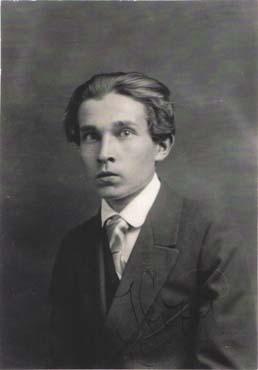
Jaroslav Siefert spent most of the 20th century being buffeted by some of the greatest forces of social upheaval you could imagine. A Czech student who saw the shell shocked and pained soldiers return from the Great War only to watch in horror as the Nazis siezed his country there after and then hail the Russians as liberators only to sour on them and confront the Soviet explotaition of Czechoslovakia as well. Seifert loved poetry, and while he made his living as a journalist it’s his poetry that won him international recognition and respect, culminating in the 1984 Nobel Prize “for his poetry which endowed with freshness, sensuality and rich inventiveness provides a liberating image of the indomitable spirit and versatility of man”
Works
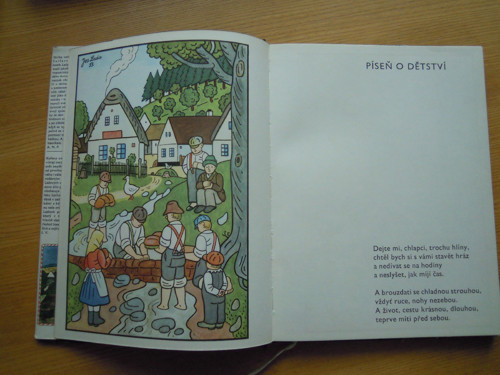
“Life is a beautiful long dream if you just live what’s in front of you”
–About Childhood (translated by me with help of Google Translate)
“I cannot tear my eyes away from that picture. It is mine, and I also believe it is miraculous.”
“Old Tapestry”
Message
In a lot of what Seifert writes, there’s a sense of difficult and being weighed down (see Background for a sense as to all the stuff that weighed him down). But at the same time there is a joy and inspiration that he culls even from these moments of bleak oppression. I translated the “About Childhood Poem” illustrated above and read it to the boys (as I had intended to from the start of this project). While Owen saw it literally as watching your kids in a river bank, Alex thought it was more about not giving up, and I saw it as appreciating the moment. Honestly, chances are that we’re all right: there’s beauty in every moment, despite the cruel whims of politics.
Position: #7 Left Winger
Seifert’s ability to speak to both trauma and hope, both defensiveness and optimism, makes him an ideal attacker who can still be an asset on both sides of the ball. He doesn’t seem to have the breadth or scope of a central midfielder, but he seems like an ideal attacker who can make the needed moves both with and without the ball. In addition to the Eastern European heritage I can easily imagine him in Vozdovac highlight reels, so his colors reflect that team.
Obviously, reading a dozen or so poems by a man doesn’t make me an expert. Come on Czech literary geniuses bring on the criticism, I’m ready!
Next Time, Contraversial 2004 Honoree: Elifriede Jelinek










 MacKenzie's Boot Room