
Background
The most recent honoree for the Nobel Committee has been lauded as one of the best writers in the world for many years now. More than a few scholars have declared it being a matter of when, not if, he was honored (though, given how many “deserving” winners ended up medal-less, I’m more inclined to say that it was some very strident projecting).

But before the universal acclamation, Kraszhnahorkai was born in a small Hungarian village to a family of both Jewish and Transylvanian extraction. He grew up studying Latin and then Law under a repressive Soviet-aligned government. Though his dad was a lawyer, he pursued the law because he sought to emulate his favorite writer: Czech master, Franz Kafka. He witnessed tragedies during military service but still found power in art, both writing and playing in Jazz and Rock groups (apparently, he wanted to write like Franz Kafka, play like Thelonious Monk, and sing like Aretha Franklin…which is as wild a sentence to consider as it is to write).
After leaving the Law, he became a freelance writer, and then literary marvel in Hungary. As the Soviet Union broke apart, he was able to explore the world more widely, including long stays in Germany and New York City. In all of it he witnessed a great deal of suffering (like his Soviet-era youth) but remained optimistic and hopeful which clearly has gone on to influence his writing, so widely appreciated. Eventually, the critics were right and he did take home the laureate for “his compelling and visionary oeuvre that, in the midst of apocalyptic terror, reaffirms the power of art”
Works
Kraszhnahorkai has a wide range of work, most of which fits in the category of “door stops” aka books big enough to keep doors open. As an added bonus, most of those massive tomes are also one sentence that ebbs and flows through any number of phrases and ideas. So reading a whole work in a month was a little beyond my abilities, but I did get through a number of essays/stories/prose poems in the collection The World Goes On, here now, a few select quotes (all translated by John Bakti)
“We are in the midst of a cynical self-reckoning as the not-too-illustirous children of a not-too-illustrious epoch that will consider itself truly fulfilled when every individual writhing in it…will finally attain the sad and temperorarily self evident goal: oblivion.”
–He Wants to Forget
“The most lasting and most profound melancholy springs from love.”
–Universal Theseus (Pt. 1)
“Good can never catch up with evil, because, with the gap between good and evil, there is no hope whatsoever”
–Universal Theseus (Pt. 2)
BONUS QUOTE! (Luckily found this within three random tries to flip pages in one doorstop)
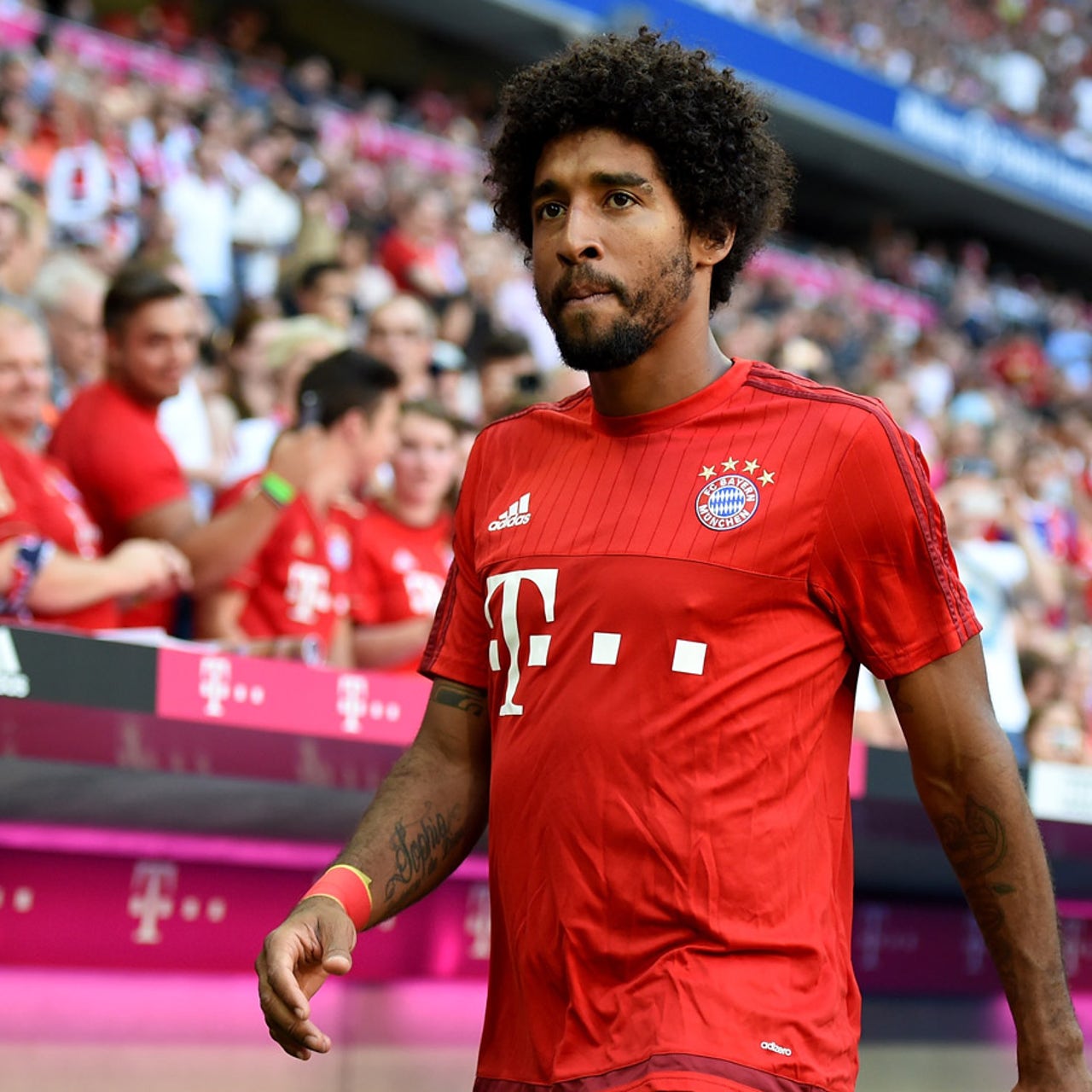
[When a conniving schemer asks to be called “Dante” another character challenges him as that is too synonymous with the famous Italian poet, but the schemer defends himself…thusly]
“getting over his surprise in one brief moment interrupted him, saying that the Baron shouldn’t think that he was speaking about a nobody here, Bayern Munchen was one of the world’s greatest teams, if not the greatest, certainly he must of heard of them–well never mind, that’s not important, the self-designated secretary interrupted, the main thing was that he proudly bore the name of Dante, because the Dante who played for Bayern Munchen, you could say, had reached his peak, and for him–he pointed at himself–such a comparison could only be advantageous, nameely it expressed that within his own realm of endeavor (the colorful world of slot machines) he himself was regarded as an expert…[the poet] didn’t matter at all, the secretary quickly replied because according to many, his Dante was the greatest rearguard ever.”–p. 137 Baron von Weckenheim’s Homecoming (trans. Ottilie Mulzet)
Message
As the committee mentioned in their citation, Kraszhnahorkai is a master of the apocalypse, but it’s not so much about the desolate wasteland of that future, it’s the existential dread that accompanies our quickly evolving, increasingly threatening modern world. He does a fine job of capturing the fear that comes within our modern global society, but (despite the often dire quotes that I selected above) balances it beautifully with artistic sincerity. Even in a time of unprecedented disaster and terror, there is–and always will be–beauty.
Position: #6

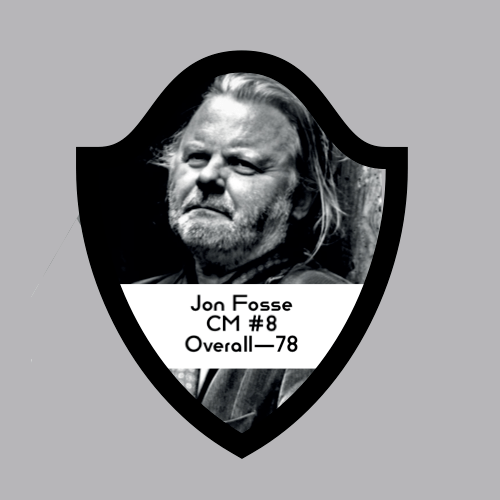
I went back and forth on this position for a while. John Fosse and Han Kang fit what I imagine to be literary equivalents of Box-to-Box midfielders, and Kraszhnahorkai has some clear similarities to those recent honorees, running the gamut of emotions through writing that ebbs and flows as well. But the apocalyptic parts of his work led me to position him more defensively (though not as far back as the “Dante” who is now immortalized in the quote I lucked upon).
I’m putting Kraszhnahorkai in as a Defensive Midfielder. He is absolutely able to dwell on defensive destruction, but there’s a silver lining there that suggests that he knows that such destruction has its own value and (here’s that word again) beauty.
I’m definitely not done reading Kraszhnahorkai (just like I’m still working on this literal doorstop I’m having for lunch), and you can jump in the mix too! I have an additional outpost of nerdery over on Fable, and have a book club for people who love high-falutin literature discussed in decidedly non-high falutin’ language: Nobel, No Bull. Come join us and try to read some Kraszhnahorkai.





 MacKenzie's Boot Room