

Quick Points Update: Han Kang was not on any of my lists for this years Nobel FC Draft. But She still gets the full star treatment here.
Background

From Kang’s Father (Han Seung-Wong far Left) and reprinted in the Korean Times
Han Kang was born in a literary family in the Korean city of Gwangju to a family that survived several traumatic childbearing experiences. That difficult experience that marked her context before birth appears throughout her writing.
So too does a love of literature as her father is both a novelist and a professor. Kang has said she grew up thinking of books as though they were “half-living beings” and to read her work is to see the ideas grow and develop and carry with them tragedy and hope in one fell swoop. (Likewise her hometown became the site of a brutal attack by a dictator against pro-democracy activists creating another trauma to grow through.) Growing up with migrane headaches, she was not very physically active, and so she built a long standing love of reading and literature.
Kang’s first work was published as poetry, though she grew into more complex and frequently meditative literature which focused on ideas, feelings, and impressions rather than plot. When she was awarded the Nobel Prize (“for her intense poetic prose that confronts historical traumas and exposes the fragility of human life”) she quickly became one of the youngest people to ever win as well as the first Asian woman.
Works
Swaddling Bands, white as snow are wound around the newborn baby. The womb will have been such a snug fit, so the nurse binds the body tight, to mitigate the shock of its abrupt projection into limitlessness.
Person who begins only now to breathe, a first filling-up of the lungs. Person who does not know who they are, where they are, what has just begun. The most helpless of all young animals, more defenceless even than a newborn chick.
The woman, pale from blood loss, looks at the crying child. Flustered, she takes its swaddled self into her arms. Person to whom the cure of this crying is yet unknown. Who has been, until mere moments ago, in the throes of such astonishing agony. Unexpectedly, the child quiets itself. It will be because of some smell. Or that the two are still connected. Two black unseeing eyes are turned towards the woman’s face – drawn in the direction of her voice. Not knowing what has been set in motion, these two are still connected. In silence shot through with the smell of blood. When what lies between bodies is the white of swaddling bands.
–“Swaddling Bands” The White Book
“The feeling that she had never really lived in this world caught her by surprise. It was a fact. She had never lived. Even as a child, as far back as she could remember, she had done nothing but endure.”
—The Vegetarian
Message
Far be it from me to read two stories and claim to be an expert…except that’s exactly the premise of these posts. If I were to name a theme in Kang’s work it would be that pain has a beauty all its own and pushes us to question what we fear. In both The Vegetarian and The White Book she explores the nature of human endurance and suffering and yet remains open to and appreciative of it in a way that confounds rigid societal expectations around her and her genre of the moment. The Nobel emphasized that trauma and fragility and to me this is very much akin to that notion, but far more appreciative and less dour.
Position: #8 Midfielder
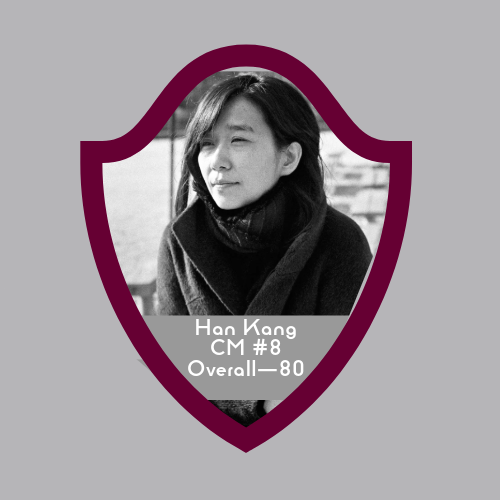
For the second straight year the Swedish Academy opted to go with a stream of conscious adjacent writer. And just like with Jan Fosse last year, I’m declaring that good enough for me to see Han Kang as a box to box midfielder, capable of both a cutting pass and a crunching tackle. She also gets bonus points from me to move her ahead of Fosse in the Starting XI because she was more comprehensible than Fosse was.
I really liked Han Kang, but I really didn’t like the delay that held me back from finishing this post for two months. Still, here it is and you can argue with me below.
 MacKenzie's Boot Room