54. Do Not Throw Away Your Shot

54. Do Not Throw Away Your Shot

In Mandarin Chinese the word Weiji, means “crisis”, but hidden inside that word is the Mandarin word “ji” or “opportunity.”

Every crisis contains an opportunity. Some enterprising sorts will use that opportunity to exploit the fears of others and enrich themselves. Others will seize the opportunity to show who they really are.

I hope that when the time comes for you boys to face a critical moments that you approach the moment How you act in a crisis should show who you are, not make you what you want to be.

Dear Boys,

The title of this essay owes itself to Lin Manuel Miranda’s Hamilton. Which, in addition to being an inventive and beloved retelling of American history, has a lot to say about the nature of people faced with the crises inherent in starting a new nation. Few characters summarize the ways of dealing with crisis better than the titular Alexander Hamilton and the show’s narrator Aaron Burr.

Hamilton sings one of the most recognizable songs in the show. At a moment of crisis, with the colonies on the cusp of independence or deeper subjugation in a losing fight with the British Empire, his arrival on the scene isn’t a saving grace for the nascent country. It’s just situation where a “young, scrappy, and hungry” immigrant is the right person in the right place at the right time to make the best of a situation.

The situation revealed Hamilton: bright, ambitious, talented, committed to his community.

The performers of Burr (Leslie Odom Jr.) and Hamilton
(Lin-Manuel Miranda) (From Deseret News)

That Burr instead decided “you spit, Imma sit, we’ll see where things land,” Isn’t an indictment of him. Some aren’t ready to act at the moment of crisis. Others simply don’t see the crisis as others do. The reticent are not reprehensible, but the opportunistic…

That is the path Burr opts to take. After establishing a theme about how he’s “willing to wait for” whatever his best opportunity is, Burr finally pounces to get his seat in “the room where it happens” by changing “parties to sieze the opportunity I saw.”

The situation revealed Burr: clever, cunning, calculating, and committed to himself.

Sports matters far less than nation building, but crises are every bit as full of opportunity. Nothing showed that better this month than the injuries to top choice goalkeepers Fatua Duda of Legon and Brice Mableu of Grenoble.

Any injury can create a club wide crisis. Goalie is especially nerve racking. There can be a steep decline from first choice keepers to second choices.

Salles, buried after penalty stops

Mableu is a club legend, a top choice keeper for 6.5 years. Duda wore the gloves of Ghana’s national team just a few months ago. Their replacements were…not.

Esteban Salles stepped between the sticks in Grenoble having played about a quarter of the games Mableu had, in three stints at lower level clubs. Winfred Honu took over in Legon 13 years younger than captain and team leader Duda.

And yet, both Salles and Honu rose to the occasion. Salles has become a penalty kick magnet, and his only loss came to perennial big spenders/title contenders AS Monaco. Honu hoisted a floundering Royals side off the foot of the table without suffering a defeat yet.

(I will explain Ghanaian naming conventions another time)

These performances don’t mean that Salles and Honu are better than the men they replaced. Whenever the number one keepers come back, it’ll be back to a life of warm up suits and extra training reps. But it does show who they are: prepared, poised, ready to offer their all to a team in need.

Honu and Salles are what Hamilton reflects in its leads. They are men who meet the moment, showing consummate professionalism in their actions and sincere strength of character, prepared to be themselves at this opportune moment.

I hope you look to them, to all those who rise up in the crucible of crisis. Dang, you’ll amaze and astonish.


53. Modern Manhood

53. Modern Manhood

Dear Boys,

The world makes it pretty easy to be a man. Men have been in charge of world affairs for such a long time that we’ve more or less made being men (especially white men) the easy bit, and made everything else more challenging.

But just because something was done that way before, doesn’t mean we have to keep doing it that way forever. Just because traditionally men were appreciated for their strength, or their swagger, doesn’t mean that’s the way y’all have to be too. (Assuming your gender identity is male)

I bring this up because news last week forcefully reminded us of that fallacy and because my soccer feelings from this week responded very well.

To start with: the fallacy.

There are a sort of men in the world whose faces ripple and snarl, like a bubbling volcano. They maintain a swaggering macho bluster in order project some sense of strength, ferocity, and power. If their style could speak for itself, it would say: “I am the manliest man who ever manned!! Don’t you forget it!!”

These proponents of “masculinity” have a hard time admitting their weakness, their vulnerability, and their fears. Instead they blame others, posture for a fight, and radiate anger.

For four years now, one of the ugliest proponents of this breed of manhood has been at the head of our government. He literally, this week, had his campaign call him “the most masculine man ever to be president.” He has rallied thousands of like minded “men” to his side. And Wednesday, when they all got together, the preening and posturing led to the attack on their own government.

Soccer, far as it is from insurrectionist mob violence, still reiterates that same view of manliness sometimes.

There’s a belief that you have to be “hard”. Return injury with injury. Play through pain. And just generally prove that you are a man (preferably by belittling other men).

Players show this in pointless shoving, bumping and antagonizing. Coaches show it by attacking any critique, belittling various foes, and diminishing anyone who doesn’t reflect their views of how a player ought to be.

But it doesn’t have to be that way. Not in soccer. Not in general society. One of the finest examples of that is a fictional coach: Ted Lasso.

Ted Lasso and the Redifining of Manhood

Your mom and I just finished this series, and it’s both funny, sweet, sincere and serious. Ted May seem a bit buffoonish, but beneath the comedic veneer is a welcome antidote to the macho manners of other Americans and athletes.

Ted says repeatedly that he measures success differently

For me, success is not about the wins and losses. It’s about helping these young fellas be the best versions of themselves on and off the field.

Jane Becker (Ted Lasso, S1.E3)

Sometimes that means pushing them to run faster, tackle harder and go for glory. But most of the time it means inviting them to be vulnerable, to understand rivals and forgive yourself your mistakes.

He doesn’t blame, bluster or berate. He shrugs at the insults and dismissals of others, returning time and again to a belief in the value of everyone. Antagonistic reporters, surly supporters, petulant players, he has a smile and kind offering for everyone.

That method transforms the locker room. Not into world beaters, but into fuller forms of themselves. Beyond serious sportsmen, they become more comfortable in who they are: admitting failures, admiring others, owning the anxiety that comes with having one thing define you from the age of 13 and wondering what to do if you can’t do that.

I cannot imagine that introspection, honesty, or temperance in the horde of manly men who attacked the Capitol last Wednesday.

If the innermost feelings of those macho men could speak, I’m quite sure they would deafen us all with fear. Fear of being inadequate, fear of failing, fear of being forgotten. They are terrified, but cannot bring themselves to admit it, and rely on macho make believe to deflect from confronting their reality.

That fear is nothing more than the long shadow of ignorance. In particular the ignorance about all the ways you can be a man. You can play hard and sing out your love for everything and everyone. You can pursue athletic excellence while baking cookies and brushing up on your YA Sci-Fi. You can lead a nation while asking questions and admitting you aren’t sure.

All this to say, being a man has less to do with strength (as the president assumes) or dominance (as many managers believe). Being anything means being the best version of yourself.

52. Lessons from 2020

52. Lessons from 2020

A year ago, I stared this blog with the thought of how I could share life lessons and understandings that can show us what matters. An added perk of this is that, much like your uncles and I started keeping a list of lectures your grandpa was going to give us, now you have a list of my 52 lectures in 2020.

Dear Boys,

1. All our teams and how out of many, we are one

2 Legon Cities FC and appreciating new beginnings.

3 Grenoble Foot 38 and the importance of giving a fork about what you do, not over how it is received.

4 Transfer Rumors and John Fowles’ three types of people

5 Ross County, Rabbie Burns and how we want to do hard things because they are hard to do.

6 SC Freiburg and why “why” is one of the best questions you can ask.

7 Impeachment, Jersey Swaps and how gracious living is easy to do if you practice when it’s hard.

8 Minnesota United, Luis Amarilla and why, While it’s easy to fixate on the best, don’t let it distract you from the very good right in front of you.

9 Ross County and the value of playing to the whistle

10 Manchester City, Mike Bloomberg and why you ought to use your power thoughtfully, with truth and talent.

11 You can’t avoid burnout, but you can acknowledge it and select the most vital and most life giving tasks to focus on.

12 Covid Closures and why even if we’d be okay, we need to do what’s best for the others around us.

13 Rosenborg BK and how you are both a hope surpassed and a history alive

14 FK Vozdovac and why none of us are ideals

15 Diego Maradona, Macho Man Randy Savage and how to make believe safely

16 Ross County and why what you are loyal to is just as important as the loyalty itself

17 SC Freiburg and why you should keep curiosity in your mind and change in your heart.

18 Why debating all time greats is fun, but also pointless.

19 University of Montana Grizzlies and why I hope you have a fire in your heart, and a light in your eyes

20 Minnesota United and how we are stronger together than we could ever be alone.

21 Japanese Art, Freiburg and why you should appreciate what a thing is

22 Screw you systemic racism

23 Hope Solo, Megan Rapinoe and why you should look inside yourselves and ask “how can I help?” as often as possible.

24 ignore those who urge you or anyone to “stick to sports”

25 Freiburg, Vozdovac, and why you should extend yourself and others a little grace.

26 Protests, FK Vozdovac Hooligans, Freiburg’s Vincenzo Grifo and why you should never confuse a crowd’s approval with your virtue.

27 Star Wars, Freiburg, Rosenborg, Donald Trump and why leadership without accountability is just authority.

28 Rosenborg BK and why you can’t prepare for the future by trying to recreate the past

29 Rosenborg’s Women, Ross County, Racialized Debates and why context is king.

30 American Soccer, American society and how a team of competing individuals can lose, but competitive individuals together on a team cannot.

31 Emelec and why you should leave more than you take

32 Ross County and why owning your struggles, your instabilities, your pain is the most healthy way to handle it.

33Minnesota United and why you should keep your goals within your control

34 Grenoble Foot 38 and how you are never alone in the world if you have people you can rely on.

35. Black Lives Matter

36 Julie Blakstad, Marit Clausen, and why you can absolutely do things alone, but helping someone else succeed often helps you too.

37 Pedro Martinez, the Great Falls Dodgers, Freiburg, Minnesota United and why you shouldn’t begrudge players leaving our teams behind, appreciate what they brought while they were here.

38 Alebrijes de Oaxaca and why you should enjoy what your style is.

39 Ruth Bader Ginsburg, the University of Montana, Women’s soccer and how contributions of women lead to growth

40 The Minnesota Twins, Alebrijes de Oaxaca and how learning loyalty is rewarded with loyalty of its own.

41 My least favorite coaches and why what goes around comes around.

42 Professional athletes, teachers and how everyone benefits from a break.

43 Freiburg’s Men, Rosenborg’s Kvinner, Joe Biden and why when you’re worried it will all go wrong, just try to do what you know to do.

44 Franco Arizala, Alebrijes de Oaxaca and why nothing is worth letting the whole world burn.

45 Asamoah Gyan and how we are marked by our pain, both in scars and in strength.

46 Donald Trump, Minnesota United, FK Vozdovac and why you don’t fight the fights you can win, you fight the fights that need fighting

47 Legon Cities and why when you have to face the future, you should approach it as an opportunity to seize not a challenge to be feared.

48 Diego Maradona and why it’s best to love the good in all people

49. Ross County, Rosenborg’s Kvinner and why there’s something to enjoy in both expected and the unexpected events.

50. Minnesota United & why you don’t need to worry about losing, especially when you can just enjoy living.

51. Punjab FC & how what we build, is built with others

52. So…what does all this mean for you boys, for what I think matters and what I think is important. This challenge to write over fifty posts with an eye to you boys and to what matters most.

There are plenty of overlapping themes, but the things that stand out most are simply these two: live in community with others and appreciating both the good and the bad.

And in case there needs to be one more individual lesson it’s this: know how to fold them. I love you boys. I love soccer. I can’t keep writing two posts a week. I’ll keep this site, I’ll post updates and results. But I’m going to scale back my lectures, both for my sake, and for yours.

51. What we build

51. What we build

It struck me that I ought to explain a little bit about why we cheer for the teams we do. Well, in part, it’s because I thought we ought to, and I’m the one of us most capable of complex thought and logic. But also, each team has a special something that captures part of what I love about life, and part of what makes you who you are.

So periodically (like during international breaks, long holidays, or say, global pandemics that completely alter everything we understand about our lives and ourselves), I want to introduce you to the teams we are tied to.

Our eleventh, and final team to meet is a team that shows that whatever you accomplish, you will accomplish it with others.

Dear Boys,

Wherefore Punjab FC

Your grandma has a theory. She believes that geography can shape societies. Growing up on Montana prairies, people were as open as the wild outdoors. Whereas those in the mountains tended to prefer a little isolation, like craggy, inaccessible human peaks

When I lived in India, that bore out. In the Garwhal hills of northern India, people were more independent and defensive, on my trips to the flat land, especially to Punjab–the agrarian state due west of my home, people were more open and eager to greet whomever they met and to support their neighbor as easily as my neighbors were to lend a cup of sugar or help hunt for a missing dog.

So it was that I fell in love with Punjab. As much because of the people and their values as because of the terrain. Though, to talk to your grandma, they often align.

Who is Punjab FC

In 2005, the year I applied to teach in India, Ranjit Bajaj started a youth sports club with a clear goal: to create a pipeline of talented kids who would, in 30 years, compete for the World Cup.

Ten years on, that team had proven to be a force among youth sides and, suddenly, the India Hero League. As Champions they seemed stronger than ever, but a new partner and a shortened season threw prior plans for a loop.

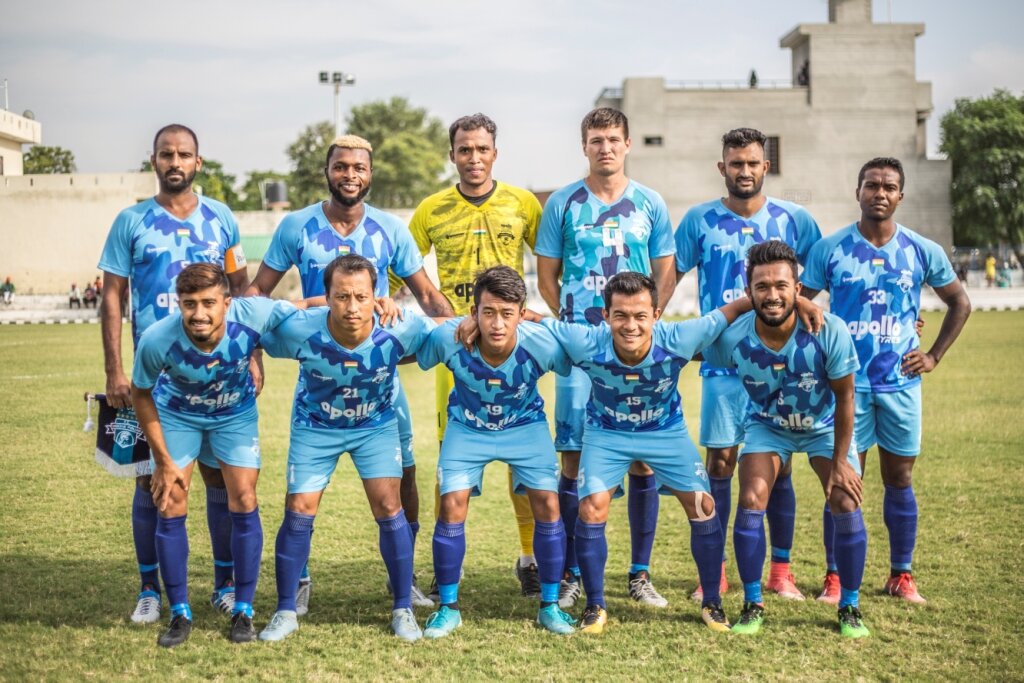
Now, two teams claim the Punjab FC Legacy, Minerva Academy and Roundglass Punjab FC. The first is Bajaj-ji’s project, still aiming for a Cup challenger in a little more than a decade. The second bears the name of Gupreet Singh’s business. Roundglass aims to support wellness for all through data and health programs. Hence the combination of training, teaching, and building a top tier club.

Roundglass will play in the I-League next year while Minerva stays focused on training. Time will tell how teams evolve from here, but both share a valuable vision.

How are we Punjab FC

One thing I hope you boys learn from me, that I learned from both Montana and Punjab, is to respect how what you have, largely depends on what others before you have done.

It reminds me a lot of what former President Obama said almost a decade ago. “Somebody helped create this unbelievable [system]…that helped you succeed.”

Your grandpa Mark started a business that has grown and grown. But he didn’t pave the road to work, he didn’t teach his employees their ABCs and 123s, he didn’t build each part and make every sale, he had a team. The business’ success isn’t just his it’s theirs, and all the people who helped them along the way.

I teach kids, but I don’t feed them before school or limit their screen time to complete it at home. Your mom markets classical music but she doesn’t play the cello or rig the lighting.

When Punjab FC takes the pitch this year, it won’t be Ranjit or Gupreet’s team, it won’t be the managers’ or the players’ or the fans’. It will be a shared experience. As President Obama’s rival, Governor/Senator Mitt Romney, once said

“you didn’t get here solely on your own power. For most of you, loving parents, sisters or brothers, encouraged your hopes, coaches guided, communities built venues in order to organize competitions. All Olympians stand on the shoulders of those who lifted them.”

The Golden Temple’s Golden Hour

Punjab as a place thrives because people care for others. Every farm, every temple, every shop, every football club succeeds because others strive to succeed. Roundglass is indebted to Minerva, and Minerva to Roundglass. They share the privilege and the power of Punjab FC.

You are indebted to your mother and me, and our parents, and our friends, and your teachers, and the random kindness of Punjabi families who offered support and food and shelter.

What we build, we build with others.

50. Dawn of the Dread

50. Dawn of the Dread

10 weeks ago I wrote about loyalty in the midst of losing. I did it after the Minnesota Twins lost–for the umpteenth time in a row–in heart breaking fashion. And now, shortly after Minnesota United Football Club managed to win a game for 75 minutes and lose it all in just under 15, it feels a little hard to hold on to that same “it’s okay to lose because it proves our loyalty” sentiment.

Dear Boys,

The hardest part of losing is the dread sensation that it’s going to happen again, and again, and again. That any moment of happiness or optimism you might feel now ought to be tempered because a mind numbing, heart-crushing debacle might be just around the corner.

When confronted with an often repeated, almost inescapable dread of opportunities, you might well become cynical, aloof, or generally dismissive of hope.

To be honest, it’s a fair response. One I’ve succumbed to my own share of times. (I may be an adoptive Minnesotan, but, by gum, it only takes so many soul crushing defeats by your teams to feel like: “maybe, if I don’t let myself feel hopeful, it won’t hurt again.”)

If you don’t hope that it can turn out well, you can remain dispassionate about it all. You can critique your own team freely and openly. They’re going to hurt you in the end anyway. Why not curse their failures and bemoan their mistakes? What better way to prove that the outcome can’t hurt you than by affixing responsibility for the hurt with every stumble and error?

If you’re not going to be critical, you can be fatalistic. “They were always doomed, they’re from Minnesota.” “Of course it was heart breaking, it’s always heart breaking.” If it’s your identity to be cursed to lose in painful ways, it’s easier to anticipate the pain before it lands.

But the problem with both of these is that it doesn’t fundamentally change the pain. You’re not above caring if you’re critical, you care enough to criticize. You aren’t beyond caring if you’re fatalistic, you care so much you’ve made defeat your identity.

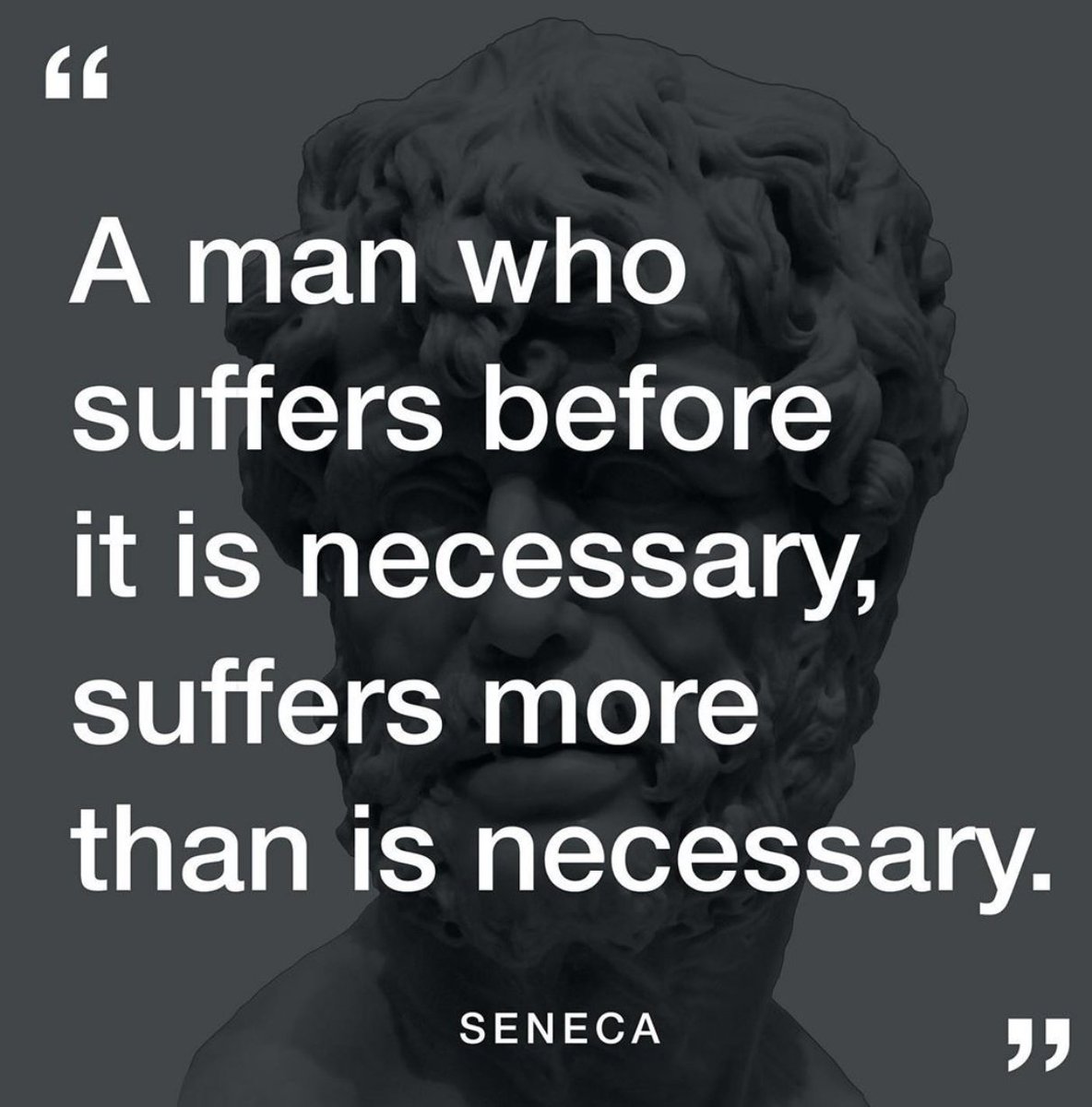
All of these attitudes allow you to worry about the outcome before it happens. And there’s a Roman philosopher who captured the problem with that rather well.

We don’t need to adopt a defensive attitude before our defenses are needed. We don’t need to critique before there is something to criticize. We don’t need to foretell our own inevitable doom if we’re going to feel it anyway.

Instead of critiquing, bemoaning, or anticipating the worst. You can take a deep breath, look back on where you came from and utter a few words of appreciation. Or, as a fellow Loons fan put it this week after the Suffering in Seattle.

I realize that I’m writing this for two boys, and I’m trying to temper my own swearing around you. But goddamn it, Jake is right. The Loons weren’t doomed. They weren’t star-crossed. They don’t stink because they lost this particular game.

They played extremely well in nearly impossible circumstances. They made a run with a dynamic attack that can come back and try it again next year. You don’t have to imagine that all of that was meaningless because it ended painfully. You don’t have to imagine that all hope is null and void if it doesn’t end with a rainbow and a smile.

You don’t need to worry about losing, especially when you can just enjoy living.

49. Shock and Awe

49. Shock and Awe

Dear Boys,

One of the trickiest parts of being a sports fan is balancing your delight at surprising results with the satisfaction of seeing talent triumph.

Last weekend we got a great dose of the former, and this weekend we will likely see a splash of the latter.

It was a shock to see the notice that “Ross County Scores!” When we knew the opponent was mighty Celtic. Unbeaten Celtic. Irredoubtable Celtic. It was even more of a shock to see the second goal come in for the Staggies as well.

Same Alex, Same.

As I wrote in the weekend review, Ross County was an absolutely shocking winner. Even though Celtic hadn’t dominated of late, they were Celtic, and at home, and riding an 8 match winning streak against County. The Staggies chances were cast off with a laugh.

Then it happened. And the sheer disbelief on Alex Iacovitti’s face mirrored the delighted shock on faces from Dingwall to our doorstep.

That chance to shock, astound and delight is part of what makes sports special. Delighted surprise and unexpected joy: not a bad way to spend a Saturday.

Next Saturday, Rosenborg will face Klepp in the last match of the Toppserien. The will probably win and seal second place. I don’t frequently adopt such confidence, but Rosenborg’s Women have given me no reason to feel otherwise.

This year there have been few constants: death, critical mishandling of facts, and points for the women of Rosenborg. They’ve lost once in 19 games.

Always a pleasure, never a chore.

They’ve been great with Marit Clausen leading the attack, and with Julie Blakstad cutting in, and with Lisa-Marie Utland capitalizing on stretched defenses. They’ve won going away and late. They’ve battled to stalemates and they’ve had lucky equalizers. The one thing they haven’t done is play badly.

That’s a second great pleasure of sports. Seeing talented athletes do what they do so well. Astonished amazement and sincere appreciation: a great treat before you start the work week.

Sports show us a lot, that’s the whole premise of this blog after all, but one of the best/simplest lessons is there’s something to enjoy in both expected and the unexpected events.

48. Diego’s Divinity

48. Diego’s Divinity

Back in April I wrote about Diego Armando Maradona: a Legendary talent with a talent for living like a legend.

I used Maradona to make the point that too much make believe can hurt you. Maradona’s make believe cost him his health, his career, his family, even–it seemed–his grip on reality. Yesterday, it cost him the ultimate price, his life.

Dear Boys,

In a matter of hours the world filled with paeans to his talent, his skill, his style, his sweetness. A world with a shortage of global icons mourned together.

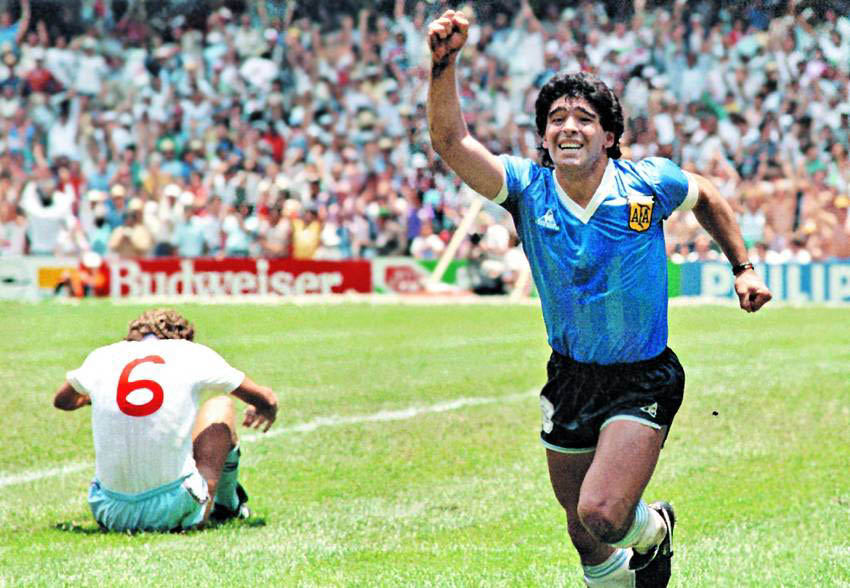
Diego in 1986
(Wikimedia Commons)

As I wrote in April, Maradona was always more of a myth to me. The tall tale legend of Maradona captured dominating opponents, running roughshod over rivals on the field, and shocking supporters outside and inside the stadium. Diego bought into the invulnerable Maradona persona but at the cost of the very human body of Diego.

But what I wrote then isn’t the end of the story. While make believe “Maradona” did burn out Diego’s candle, it lit a spark for the world.

Diego in 2020 (Aljazeera)

The outpouring of tributes this week isn’t made up. The effect Maradona had is real. The tears shed for him are shed, not in ignorance of how he suffered, but with appreciation of a flawed man’s complexity.

Love the good in all people. It’s easy to do with idols and heroes. We can forgive Maradona’s shortcomings because of how he inspired the world. It’s harder to do with every day people, but no less important. The spate of infuriated protestors across the street are difficult to deal with, but I strive to love them for advocating their beliefs just as I love Diego for struggling with his demons.

I hope you boys learn that, while not every person is admirable, everyone deserves your affection. We love others not because they earn it on the field or by their allegiances, but because we all struggle to be our best selves. You, me, the masked and maskless and Maradona.

47. Face the Future

47. Face the Future

It struck me that I ought to explain a little bit about why we cheer for the teams we do. Well, in part, it’s because I thought we ought to, and I’m the one of us most capable of complex thought and logic. But also, each team has a special something that captures part of what I love about life, and part of what makes you who you are.

So periodically (like during international breaks, long summer holidays, or say, global pandemics that completely alter everything we understand about our lives and ourselves), I want to introduce you to the teams we are tied to.

Our tenth team to meet is a team that embodies the hope and optimism in a new vision of the future, Ghana’s Legon Cities FC.

Dear Boys,

Wherefore Legon?

Across the Atlantic, there’s hope and opportunity. That’s what your European relatives thought before they left Scotland, Norway, Serbia, and Germany (via Russia) to come to the United States.

They had hope because others were taken and brought across the same water without hope. Our opportunities were paid for, in part, with the blood and pain of others from Africa.

Centuries later, we can find opportunities for both ourselves and some of those most harmed by slavery. Africa is a continent of hope. Ghana is a country of invention and imagination. Legon is a city where the future comes to be real.

I studied in Legon during college. I made new and vital friends, read a lot of great literature, studied with excellent professors and poets, and taught amazing students. I enjoyed it so much, I did it again 5 years later. Legon is a special place. It is the future of a growing nation, and will help shape the future of our changing world.

Who is Legon Cities?

Legon Cities bringing the flash

A few years ago Ghanaian football was in trouble. Leaders in the country shamelessly solicited bribes. The league was plagued with allegations of cheating. And money for investment was scarce.

Enter Richard K. Atikpo. A well heeled oil tycoon, he swooped in to buy Wa All Stars, a northern team whose prior owner was in a heap of trouble, and move them to the Accra area, rebranding them Legon Cities.

In doing so he sought to build and brand a new kind of team in Ghanaian football. A team with as much flash and flair as a rock concert and as much ambition as the biggest sides in the game.

How are we Legon Cities?

It’s not that we have flash and flair. It’s not that we’re changing the game. But when the future comes to bear, Legon Cities is a symbol of what we aspire to do.

Heading into our future

When you have to face the future, approach it as an opportunity to seize not a challenge to be feared.

Ghana is going to shape the coming century. All of Africa will too. Our countries will become more diverse, more connected with the wider world. When they do, we ought to be Legon Cities. Accept the change and make the most of it.

We can say that we’ve backed Legon Cities from their start, even though that start was just a year ago. They’ll be near the future of football. I hope we are near the future of our world too.

46. The Fights that Need Fighting

46. The Fights that Need Fighting

Just about all the oxygen in any news space for the last two weeks has been sucked up by the American Presidential election.

That is with good reason. Everything ties back to the person picked to run the biggest economy, biggest armed-forces, biggest diplomatic-force, and most influential culture shaper on the planet. Yes, there is unrest in Central Asia and another spike in the Coronavirus disease, but the President of the United States is uniquely situated to handle both in the same hour.

That is, if they choose to.

Dear Boys,

One of my favorite lines from one of my favorite writers is simple: you don’t fight the fights you can win, you fight the fights that need fighting.

Actor Martin Sheen delivered the line…and is awesome

It comes from a movie about an American President (conveniently enough, titled, The American President) as the chief of staff tells a re-election minded president to stop strategizing and start doing what must be done.

I think about that a lot, because politics has become a place where the fights you can win, and the fights that need fighting are getting confused over, and over, and over again.

To step away from global affairs for a minute: this election has been ridiculously divisive. Not just between different parties, but between friends within the same party. Two men I deeply respect, both of whom I’m happy to have worked with, both of whom I’m happy to talk to, descended this week into an absolutely irrelevant fight over which hypothetical candidate would have done better as a presidential candidate and how their differences reflect a classism/ignorance that disgusts the other.

This is not a fight that needs fighting.

Debating what our goals out to be is fair, reviewing your personal biases is worthwhile, but dying on a hill over a hypothetical situation is ridiculous. It’s like saying that, if Asamoah Gyan had made his penalty against Uruguay, Ghana would have won the World Cup and he’d be winding down his career as a Juventus legend right now (rather than suiting up for Legon Cities).

Yes, that’s possible. But we have no way of knowing. And what’s more, it simply isn’t important enough to castigate those who disagree with you.

That’s anathema to our current president. A man who has never held back from a fight he didn’t need to fight.

To him a petty insult on social media is a ten alarm fire. A half-assed attempt at social consciousness is a Category 5 catastrophic disaster. An apparent personal failure is a clear and demonstrable sign that the end times are nigh, so take arms good Christian soldiers, take arms!

He is the king of fighting fights he can win, regardless of whether or not they need to be fought. He promised “so much winning” and to the eyes of many he’s delivered. (Despite the fact that the victories are pyrrhic at best, and–more often–totally invented.)

So, of course, he is fighting another fight that doesn’t need to be fought now.

He has been defeated. The experts who judge elections say so. The officials who tabulate votes say so. Behind closed doors, his friends and family say so.

But he’s fighting anyway. Unfortunately, he’s fighting what doesn’t need to be fought: imagined voter fraud, make-believe master-conspiracies, and totally valid critiques of his awful performance as president. He’s fighting all these so that he can continue fighting pointless fights he can win from the comfort of a presidential motorcade.

Robin Lod and fellow Loons couldn’t win, but it deserved a fight
(Pioneer Press)

In soccer, the game isn’t over until the final whistle. It’s thrilling to see teams hustle, and sweat, and strive to win. The Loons stealing a tie when the result didn’t really matter. (Harry Kane pipping a win for the premier league team I try not to talk about). Heck even Cukaricki getting a questionable winner to deny our friends in Vozdovac. Those are great moments, because playing with pride is a fight that’s worth fighting.

Protecting your ego, diminishing someone else, scoring a point on a hypothetical argument you can never prove: not worth it.

Fight the fights that need fighting boys. And if you’re not sure if it needs to be fought, just ask: would Donald Trump fight this? (If yes, then step back boys, step back.)

45. On Pain and Going Home

45. On Pain and Going Home

Dear Boys,

If you boys end up sports fans, especially sports fans like me, you are going to have some hard defeats to swallow. The Vikings Wide Right? Sid Bream scoring from first on Barry Bonds? Basically any Yankees-Twins game?

But more than almost any other, when I think about the hardest losses, I think back to a match I watched on a warm, dark, night, with a plate of jollof rice, a roasted tilapia, a wine cooler, and a bunch of new friends.

I think about the “New Hand of God”, the last chance for “the hope of Africa”, I think about Luis Suarez v. Ghana in 2010.

Always an Ant. Love WASS

I had spent a month interviewing young Ghanaian student/actors about their sense of national identity and teaching Literature and Composition classes at a local high school ( “Playing the Part” pub. 2011 Bowling Green State University). At night, I’d call your mother, then my fiancee, and transcribe interviews while watching matches from the World Cup in South Africa.

A few days before, the US had been bested by Ghana…again. I’d been roundly jeered and jostled by every Ghanaian I lived near, worked with, and taught. By the next match, Friday, July 2nd, we were all friends again, and I was taking the night off from interviews to talk to the love of my life and watch the Black Stars.

It was…horrible. First there was the lead, the baffling long-distance strike from Sully Muntari. Then the anxious despair to stop any goals from the talented tandem of Diego Forlan and Luis Suarez. When Forlan equalized it seemed to doom us all. But the Ghanaians grew into the match, asserting themselves again and pushing on. When John Pantsil lined up the free kick it felt inevitable, and to see Stephen Appiah and Dominic Adiyiyah pounce, we were bubbling to burst into cheers.

Then…disbelief. Agony. Anger. Defeat. Suarez had stopped a clear goal with his hand. It was unfair, unjust, unbelievable. Instead of celebrating a hard fought but well earned victory, it was back to the penalty spot for baby striker, Asamoah Gyan.

I think it was Adama, my host teacher, pacing in front of the bar, who said, “no, no…not Gyan…he’s too excited-oh…”. And then…a clanging crossbar, an obviously agonizing penalty kick defeat, and a long, echoing, bitter silence. A painful feeling in a place that was so often music, and noise, and joy to see you.

That was a hard loss. It wasn’t just clearly hard for the players, or hard for me as a fan, it was hard because one whole nation, and so many more across the continent felt it. But, as with all things, it comes with a lesson.

We are marked by our pain, both in scars and in strength.

10 years on from that there’s been a recent spate of writing about the loss and the team that suffered it. But the story that comes to mind the most, is Homegoing , the American Book Award winning novel that has nothing to do with soccer, and everything to do with pain.

The book chronicles two families carrying the long legacy of trauma and tragedy from the golden coast of Ghana all the way to Stanford University and back again. It is beautiful, heartbreaking, and important.

Soccer isn’t that important.

Certainly a match ten years ago is nothing next to generations of stories and legends. However, there’s something about Homegoing that reminds us of the strength that comes with struggle. That through pain and degradation and angst come both our fears and concerns, as well as our strength and ability.

Asamoah Gyan went home last week. He’s said to have watched the match, and his failure at the spot dozens of times. It hurts me as a passive observer to watch it, and Gyan…it hurts him more.

I wish the match could happen again because it really hurts me every time when I’m alone. It’s something that I can never forget. I watch it over and over and over again and hope one day I can turn things around and make people happy.

–Asamoah Gyan (2014)
Baby Jet’s Return (Legon Cities FC)

But that’s the thing. The memory hurts (he stopped taking penalties for the team shortly afterward) but it also encouraged him to set a goal, a goal he’s chasing now in Legon. A goal he’s chasing down the street from where I watched him miss, from where that echoing silence seemed to bury us.

It may have scarred Asamoah Gyan, but it also strengthened him. I hope your most painful moments do the same.