

Background
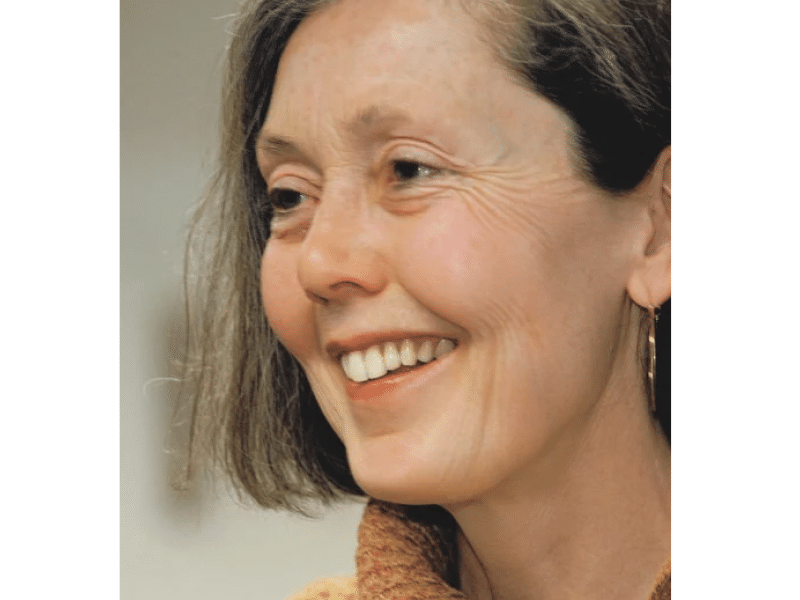
This year’s winner of the Nobel Prize is poet and classicist, Anne Carson. While Carson does not share much about her life (either in press or in her works, she seems to have had a fairly routine upbringing in Toronto and its extensions, though her work has periodically captured the sense of loss as her father, mother and then bail-jumping brother have passed away in the last twenty years. While she wrote poems on grief for each of them, she has consistently challenged the expectation that her poetry must reflect her personal expereince.
Instead Carson has drawn much more inspiration from the truly great love of her life: ancient Greek literature. In addition to spending most of her career as a translator and contributing 7 works in translation and 5 works that retell classic myths in her own poetic style. This partnership is what elevated her profile and ultimately led to her citation: “for her bold and inventive oeuvre that, in playful dialogue with the classical tradition, has created new forms for contemporary literature”.
Works
Last year, in an effort to get ahead of the drafting process, I got a hold of Carson’s seminal work: The Autobiography of Red. The story captures a legendary mythological monster, re-imagined as an awkward, uncertain gay teen who falls in love with the “hero” focused on his destruction (Herakles).
“He came after Homer and before Gertrude Stein, a difficult interval for a poet.”
“When they made love
Geryon liked to touch in slow succession each of the bones of Herakles’ back
as it arched away from him into who knows what dark dream of its own, running both hands all the way down
from the base of the neck
to the end of the spine which he can cause to shiver like a root in the rain.”
Over the summer, I got an extra work from Carson included in the Poetry World Cup. (Check the video at the right)
After the Nobel announcement, I got a hold of a piece of lyric drama: Norma Jeane Baker of Troy which takes the existing drama of Helen and connects our modern view of beauty and gossip (with Marilyn Monroe) to the classic story of beauty and retributive war.
I expect you’ve heard of the Trojan War
and how it was caused byNorma Jeane Baker,
harlot of Troy
Well, welcome to Public Relations
That was all a hoax.
A bluff, a dodge, a swindle, a gimmick, a gem of a strategem.there’s nothing mythic here,
She’s just a bit of grit caught in the world’s need for transcendence.How do you define dirt? Here is what the ancient Greeks thought of it: dirt is a matter out of place. The poached egg on your plate at breakfast is not dirt. The poached egg on page 202 of the Greek lexicon in the library of the British Museum is dirt. Dirt is something that has crossed a boundry it ought not to have crossed. Dirt confuses categories and mixes up form….The noun ‘concubine’ in Greek comes from the verb that means to sprinkle…as Helen does when she follows Paris to Troy…Helen doe snot belong in the house of Priam. She comes in tracking Greek mud all over the floor
Message
Carson is deeply immersed both in the world of classic Greek literature, study, and translations, and in the world of modern poetry. So naturally, her message has to capture both the past and the present. In a lot of these works about love, beauty, even the errant belief that a name is “a fact”, we see universal ideas, echoing the past, and revisited in the present. While this might not be the most insightful message, it is one that strikes me as truly consistent in the works I’ve read. Classic works capture our world and our world can reflect them back.
Position: #2 Right Back
Like a lot of winners who connect to the past (and to the Greek soccer tradition of grind ’em down defense), I wanted to put Carson in the back. But, given her more direct style and the ease with which she bluntly asserts issues of sex, gender, and societal expectations (all of which the Greeks just left lying around for anthropologists to trip over), I thought she needed a more attacking mindset than the others (I’m not alone as someone else imagined her as the mirror to basketball anomaly Jalen Brunson). So yes, Carson is another Wing back (right side–given the right’s interest in ancient history), but I think she might be the best suited to the role of anyone I’ve yet read.

Interestingly, I had thought Carson might be a little too like Louise Gluck (2020) to get the award, and sure enough, my brain cells put her in exactly the same spot on the field that Gluck is.
Poetry people it’s your time to chip in! Have I over simplified my Metro Atlantic 21st century female poets? Is Carson too aggressive to be in defense?

