

Author’s note: So, a couple things. First, I said Eliot won the Nobel in 1943…he didn’t, nor did anyone else–it was cancelled due to the second World War. He won in 1948, which (secondly) has absolutely no connection to anything in my 20 year time frame for this project. So (thirdly) consider this just a random writing about an author, and we’ll let that be a problem for future Me, assuming that we’re still doing this in 5 years. And finally, I’m sorry that I misnumbered WB Yeats as a #3 (Left Back) when he’s more accurately numbered as a #4 (Centerback), the prior entry has been corrected to reflect this.
Background
Thomas Stearns Eliot won the Nobel Prize in literature for his poetry and drama in 1943. In its citation, the committee simply asserted that they wished to honor “his outstanding, pioneer contribution to present-day poetry”.
Eliot was part of that lost generation of writers, with big ideals and high hopes who found themselves resettled in Europe as adults, disenchanted with America’s failings. Like others, Eliot had come from a fairly well to do stock, enjoyed a rich education and built much of his work by alluding to and building on other well known works but in a rather startling method of slamming works together and building thematic meaning from the various images that emerge from it.
Works
From: “The Love Song of J. Alfred Prufrock”
There will be time, there will be time
–1915
To prepare a face to meet the faces that you meet
There will be time to murder and create,
And time for all the works and days of hands
That lift and drop a question on your plate;
Time for you and time for me,
And time yet for a hundred indecisions,
And for a hundred visions and revisions,
Before the taking of toast and tea
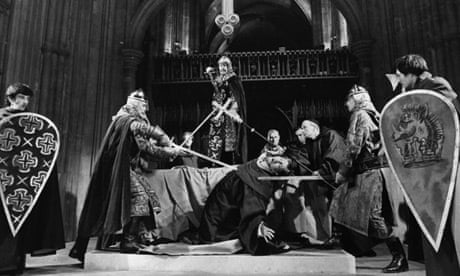
From: “Murder in the Cathedral”
Yes! men must manoeuvre. Monarchs also,
–1935
Waging war abroad, need fast friends at home.
Private policy is public profit.
Dignity shall be dressed with decorum.
Your Opinion
I can’t always do it, but when it works out, I’ll share writings from our laureate. Eliot’s has an only moderately mature collection of poems titled Old Possum’s Book of Practical Cats. When we found a copy illustrated by Axel Schaeffer (the man behind drawings in beloved picture books The Gruffalo and Room on the Broom), it was clear that there was an opening to try it out with you.
The results: Alex: “It’s funny and good, and also I’m all done.” Owen. “No! Not that”
Message
There’s a lot lying within Eliot (including the ability to be both good and not at all enjoyable at once). There’s beautiful aching, and bitter realizing. There’s a subtle appreciation of the past and a slam-bang-crash of the uncertain future. There’s a willingness to see both sides of the coin, the arguments for and against and the awareness of complexity in all things. To put it in as direct a way as I can think of: all that is beautiful rises from and ends in destruction.
Position: #6
With a view that bleak, and a style that multi-faceted, Eliot seems to me well suited to a role in the middle of the field where he can both create art and cause chaos. There’s a position like that in modern soccer, one that is often mocked as dirty work or unpleasant, but also does something that no one else on the field does in the same way. It’s the defensive midfielder role, and while I certainly think that Eliot was much too cerebral to be an out and out beast, he certainly could keep up with a high level of play and obtain the respect that he clearly deserves. It calls to mind a player like Ozzie Alonso, who spent his time in Minnesota altering the level of play while never reaching a heroic ideal.

What do you think? Is Eliot more of an eight? Have I totally whiffed on my attempted analysis? Leave a comment below…please.
 MacKenzie's Boot Room