

Background
Elfriede Jelinek is the first female writer we’ve covered in our Nobel Laureate reread project, and she is a truly distinctive voice in contrast to what else we’ve read in this project.
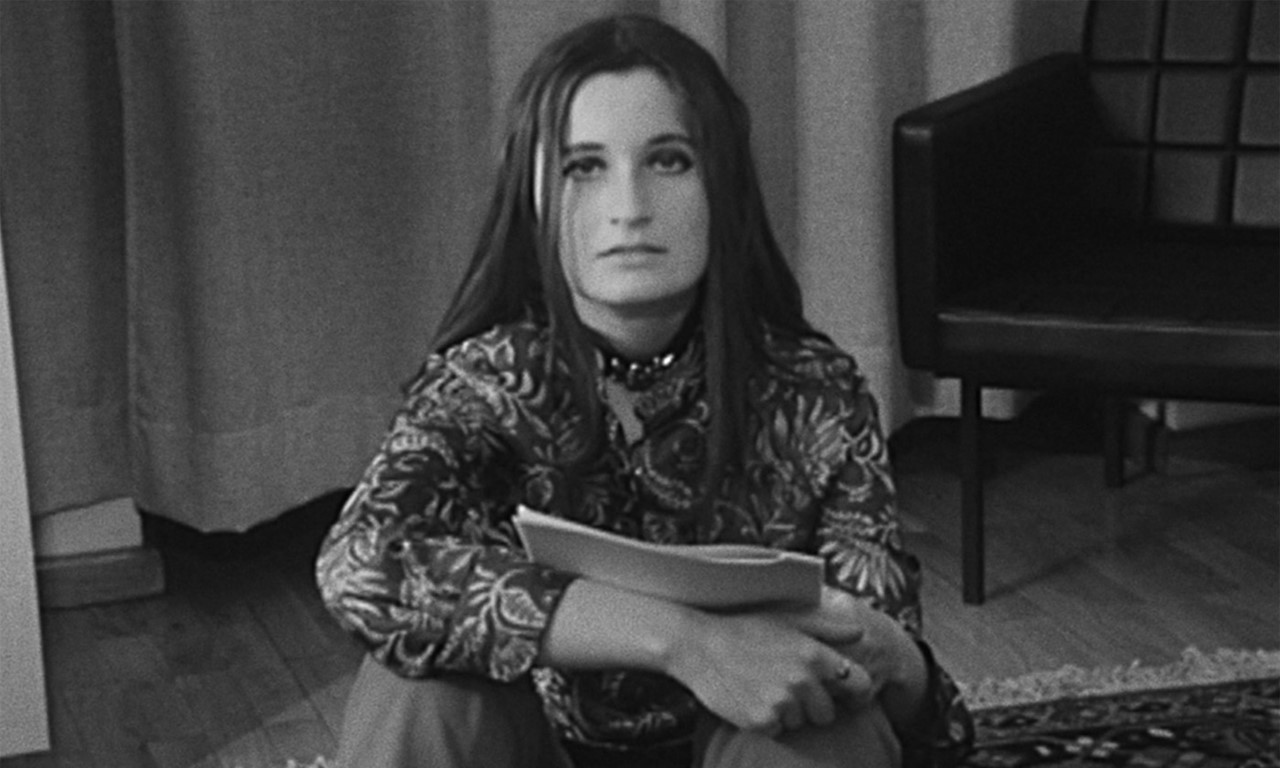
Jelinek was born in Austria shortly after the fall of the third reich but with a family that connected both to Austrian high society and Czechoslovakian Jewish community. She began her writing career as a poet before moving into fiction and then drama, all the while maintaining frequent poetic interludes that border on free verse stream of consciousness (the kind that is…challenging to parse). While she has long been widely appreciated in German literature, but less widely known in translation. She was taken aback by being given the Nobel in 2004: “for her musical flow of voices and counter-voices in novels and plays that with extraordinary linguistic zeal reveal the absurdity of society’s clichés and their subjugating power”. She was not alone as one member of the Swedish academy resigned following her prize calling her work: “whining, unenjoyable public pornography”, and “a mass of text shovelled together without artistic structure”. She’s also had a documentary that calls her a “linguistic terrorist”.
Jelinek still writes, but as someone who struggles with agoraphobia and paranoia, she did not accept the award in person (like Jean Paul Sartre 40 years before).
Works
“Erika distrusts young girls; she tries to gauge their clothing and physical dimensions, hoping to ridicule them”–The Piano Teacher
“We made these nothings [athletes] into greats, into disturbers. Into heavyweights. We commoners, we who can never get used to our lives. The quiet want to be loud, but the loud don’t want to be quiet”–The Sports Play (Die Spielstruck)
“As much as football can cause war, it can also cause peace; football is a kind of Geiger Counter of civilization, a catalyst for good as well as bad.” (2012 Interview)
Message
Elfriede Jelinek is a truly combative writer. While the Nobel committee first cited her musical flow, I found myself considering another aspect of her writing the committee also noted. Her works “present a pitiless world where the reader is confronted with a locked-down regime of violence and submission, hunter and prey.” The psycho-sexual drama of The Piano Teacher (as seen in the well regarded 2001 film) is all about hunter and prey. While sports is all about two opponents, her play about sports builds that to an extreme degree leading to violent confrontations and ideological duels. To me, her writing seemed to revolve around a rather dark and dire message: we must constantly struggle–with one another for power, and with ourselves for control.
Position: #3 Left Back
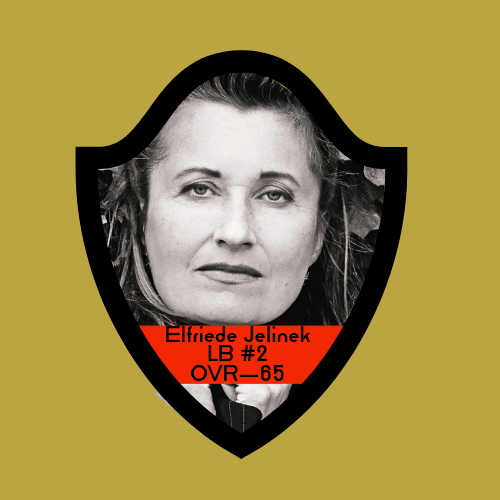
That combative confrontational tone put me in mind of a defender, especially an aggressive one who might both attack down the flank and also have to rush back to stop others, so I’m going to play Elfriede as a fullback. (I’m also tipping my cap to her socialist politics by putting her on the left side, and using the colors of my favorites at Freiburg who also have a fondness for defensive Austrians.) While there’s some real powerful ideas in Jelinek’s work it is also QUITE difficult to understand and “mass of text shovelled together” seems a fair critique to me. I’ll gladly acknowledge she can do some impressive things, but it’s often hard to wade through the confusion to find it.
Now there are definitely flaws with my assessment so…for the 14th time, I invite someone, anyone to write a comment rather than just leave a like. Would I see it differently if I saw her work performed on the stage or the radio? Would it be different if my German was stronger? If I wasn’t blinded by my masculinity? Seriously, anybody, help me out here…
Next Time, 2024 Honoree ??
We’ll cover the possible contenders at the start of October and review the winner in November. Then start this whole mishagosh over again in January with the 20 year cycles of ’05 Winners
 MacKenzie's Boot Room