

Background

William Golding was born in 1911 and followed in his father’s footsteps to become a teacher. He was a youthful optimist who came to view the world more cynically following a tour of duty during the Second World War (“man produces evil as bees produce honey”). After the war he continued to write while teaching and ultimately published his first novel: Lord of the Flies (a book that has been thoroughly cemented on reading lists). He continued to publish, winning some recognition and awards for his other work, but always being marked apart for his first. In 1983 (my birth year) the Nobel committee gave him its award. They noted “his novels which, with the perspicuity of realistic narrative art and the diversity and universality of myth*, illuminate the human condition in the world of today”.
*I didn’t get this word choice until I read the following quote from Golding: “people always think that [mythic] means ‘full of lies’, whereas of course what it really means is ‘full of truth which cannot be told in any other way but a story’.”
Works
From: Lord of the Flies
“The sticks fell and the mouth of the new circle crunched and screamed. The beast was on its arms in the center, its arms folded over its face. It was crying out against the abominable noise something about a body on the hill. The beast struggled forward, broke the ring and fell over the steep edge of the rock to the sand by the water. At once the crowd surged after it, poured down the rock, leapt on the beast, screamed, struck, bit, tore. There were no words, and no movements but the tearing of teeth and claws.”
–From Chapter 10: “View to a Death”

From: To The Ends of the Earth (adapted from Golding’s The Fire Below)
“Why are we such creatures as a few sentences of an angry man should matter more than the prospect of death”
From “Rough Magic” (in the collected essays A Moving Target)
“There is one behest to be engraved over the novelist’s door. Have one hand holding your pen and the other firmly on the nape of the reader’s neck. That is rule one, to which everything else must be sacrificed. Once you have got him, never let him go.”
Message
Golding is the first writer we’ve studied for this project who primarily worked in prose rather than poetry. Perhaps it’s that more direct nature that makes his belief that while everyone can imagine themselves as genteel or respectable, we are, all of us, marked out in our more vicious, cruel, and self-serving tendencies. He makes a habit of slashing and grasping at every opportunity, it’s his way of holding on to the reader’s attention. His habits are help him to attack the hypocrisy of assumed excellence, reveling instead in a dirty rotten humanity, many would rather ignore, while maintaining that there is still something to recommend in each of us. He’s not always easy to read with his penchant for violent and vile actions, but he does apply a deftly funny satirical style as well.
Position: #9 Striker
That aggressive message and style made it clear to me that Golding would be best suited to playing in the attack. But I wasn’t sure where he should play (scoring goals like a striker? causing havoc like a winger? crafting opportunities like a midfielder?). Ultimately the style and incisive message struck me first and foremost as a goal scorer. I also noted that the staying power of Lord of the Flies overshadowing the rest of Golding’s work brings to mind a good player who is always reminded of a single timely or artful strike. So, I opted to sign him up as our first number 9 goal scoring threat.
As an added bonus, Golding is the first laureate I’ve read about who has evidence to back up the positional claim. He was a strong sprinter and cricket team captain during his school days, which leaves me to think he actually would be well suited to playing at the top of the attack (sprinting and leading).
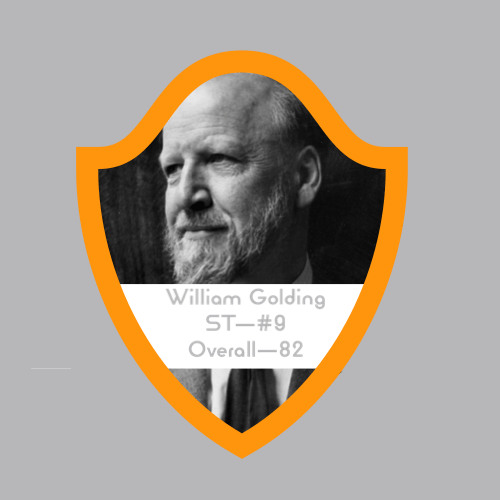
Perhaps I’m biased. Perhaps the presence of a teacher/writer/world-wide commentator and fan of Jane Austen skews my view. But by god, I like William Golding and I think he’d be a great striker. Argue with me below.
 MacKenzie's Boot Room