26. Silence the Roar

26. Silence the Roar

Dear Boys,

In soccer, as in most things, the rush of a crowd’s support is a special type of thrill.

Professional athletes know this. There are plenty of trite claims about the roar of the crowd or effect of the fans like an extra player. But it’s true. An audience can inspire greatness. It does it for amateurs and in other arenas too. My biggest audiences–a couple dozen parents at ten year old soccer finals, a few hundred at a school play, thousands of neighbors strung along a 26 mile marathon course–certainly had an effect on me. I felt bolder, braver. Every kick or joke or stride brought a jolt of excitement and purpose.

Marathon Sunday (from City of Minneapolis)

But we must do without crowds in the age of pandemic. It is strange to see players playing their trade in front of a sea of empty seats. Many leagues have turned to ambient match sounds to replace the cavernous echoing thump of cleat against ball.

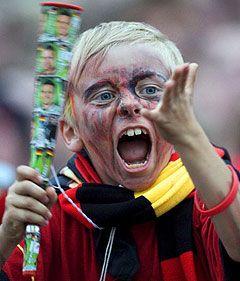
Still there’s something to appreciate in the absence of crowds and something to avoid in their presence. Despite the excitement that comes with being the center of attention, never confuse a crowd’s approval with your virtue.

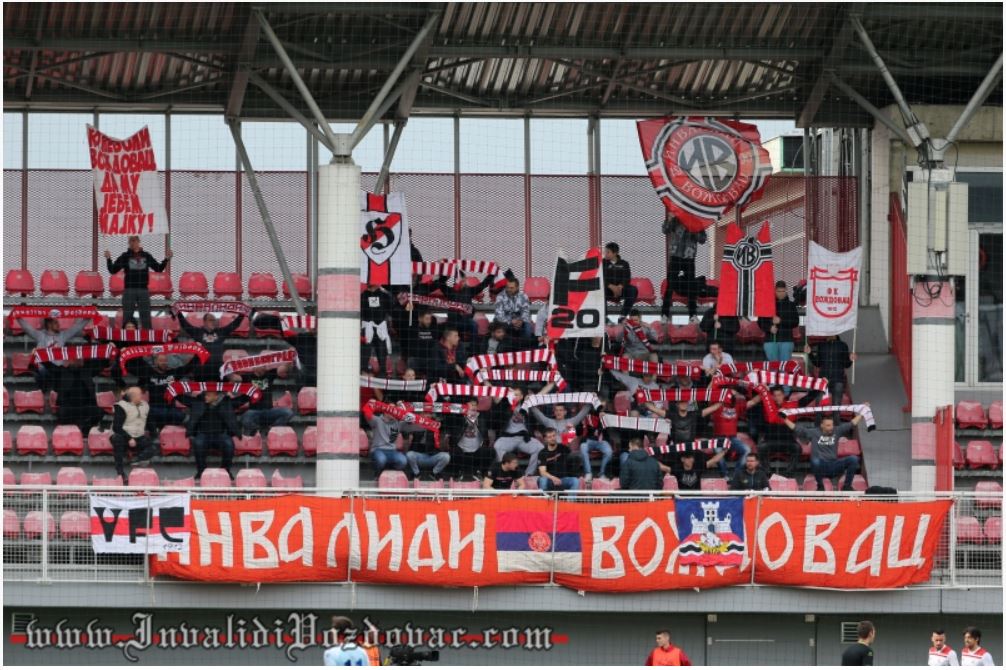
Think of Vozdovac, where fans have been back at stadia for three weeks (despite serious health professional opposition–because Serbia).
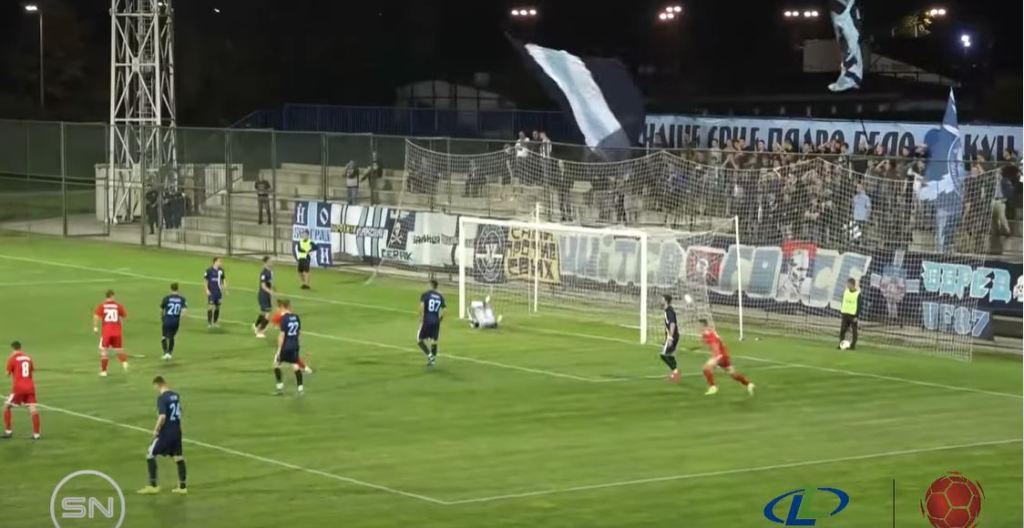
Racist symbols at Rad (from Linglong Superliga Youtube)

In the three matches where fans were present, we have several highlights of fan sections adorned with far right racist symbols: Celtic crosses, Confederate stars and bars, Reichskriegsflagge. While I loved seeing those behind the confederate flag go silent after a goal, I know that Vozdovac’s Invalid section use similar imagery.

That makes cringe. It also reminds me that crowds create corrupted logic. The entire stadium is a crowd. The fans use the flags. The club tolerates them. The players build affinity for supporters and their symbols. It all creates a vicious circle.

The acceptance by all parties at a stadium makes it okay to wave symbols of hate, which makes more people fly it, which makes it easier to accept. The crowd has created a mass delusion that racist symbolism is fine, because its theirs and the crowd validates them.

Those same cycles occur in our own neighborhoods as well.

Hundreds of protesters have torn down monuments to vile, bigoted, people. Statues that honor those who pillaged, murdered, enslaved, and belittled people of color deserve to come down and I’m glad they did. However, the image of toppling statues to cheers can invite a generalized belief that such grand actions do good on their own. Across the St. Croix river, Wisconsinites angry at an unjust arrest tore down sympathetic statues. They didn’t have reasons why. The anger of the crowd vindicated these illogical actions which incite more anger, which leads to more illogical actions.

These muddled motivations are nothing next to those who defend the racist symbols. That includes our president who called statues of slave holders, military bases named after traitors, and symbols of racial animosity “our beautiful heritage.” (Just to make this clear: Serbian football fans aren’t advocating for a more agrarian society and decentralized government…they know it’s a racist symbol, that’s why they like it.)

If all you want is applause, what you do to get it says a lot about you. (From the Oklahoman)

Again, the crowd corrupts the logic. A group that wants so badly to be different than the protesters ends up defending an indefensible target. A man who thrives on the applause of others lauds the inane logic, breeding more distrust and enmity because the cycle of cruelty, to a cheering crowd, to cruelty continues without end.

A group of politically engaged citizens, protesters, or soccer fans is not, by itself, a dangerous group. But confusing the collection of people with the confirmation of righteousness is dangerous. Crowds aren’t bad. What we do to join, to animate, or to earn the praise of a crowd is.

As a counterpoint to Serbian Hooligans and racist dogwhistles, consider Vincenzo Grifo from Freiburg. He has long been a top tier player, thriving on big Bundesliga stages, and appearing for the elite Italian national team.

Now, even in empty stadia he continues to do his best. Among all the empty stands, he know who he is and loves what he does. He doesn’t need a crowd to spur him on, and one goal suggests why.

Grifo (from SempreInter)

Consider the curling wonderstrike against Hertha Berlin. At a moment where many players might use the crowd to urge them on, the absence of support might mute your performance. Not so Grifo. He stands tall, delivers a great goal, and then runs to the nearest camera. He screams a greeting to his family and hometown. Even with an empty stadium, the inspiration and encouragement exists in his heart, his history, something far beyond a few thousand fans on a Friday night.

Grifo doesn’t need a crowd to do great things, and neither do you. By all means, enjoy a crowd, revel in the roar. Just don’t conflate a crowd with correctness.

25. Amazing Grace

25. Amazing Grace

Dear Boys,

My friend Aly once broke it down for me like this: “you’re a cis-hetero, upper middle class, educated white guy. If life were a video game, you’d be playing it on easy mode.”

That can be a little hard to hear but it’s true for me, and it may turn out to be true for you too. To be fair, at your age it’s not clear if your genders are more fluid, or your orientations are different, or where your education and careers will take you. But make no mistake, the comfort and prominence of being white has made and will make your life easier

And yet, if you’re anything like me, you will run into people who invite you to “take it easy” or cut others who look like us “some slack”.

Right now there’s a lot to do. As the protests fade into the background it’s easier and easier to let go of lofty goals and abandon your expectations. Easier still to ridicule and disparage people who take a break.

Even with all the pressure, stress, and big fights to fight, you shouldn’t take it easy. Even when someone who looks like you, sounds like you and pleads that they meant well, or were raised at a different time, and so would appreciate a little slack, be wary before you agree.

Life is easy enough already and white guys have more than our share of slack as it is.

Don’t take it easy, don’t cut people a ton of slack, but do extend yourself and others a little grace.

To some, these may sound like distinctions without a difference. Ease, slack, grace. All speak to comfort and a break from struggle. So why applaud one and avoid the others?

Taking it easy excuses yourself from the work that must be done. Cutting slack lowers expectations for some while others keep striving. Extending grace asks us to appreciate the humanity in others while holding firm expectations for what will be done and how it will be done.

(From Stream)

As a teacher, I often need to do this for students. If a kid doesn’t do an assignment, we could take it easy and cancel the assignment, we could cut some slack and grade it with the notion that this is the best they could do, or we could extend grace, offer support and sympathy, then set a plan for completing the full assignment.

C’mon Man!! (from Esquire)

There is another alternative of course: be a jerk and tell them they’re wrong. It’s a popular choice for some. It comes along with an inflated sense of righteousness and a diminished view of other people. It can feel good to tell people who fall short just how far they are from adequate. But that’s as far away from grace as you can get.

Or consider sports, players are coming back to training, but few if any are as crisp and sharp as they might have been otherwise. Now is not the time to berate or demean them as failures, nor is it the time to pat them on the head and provide a participation trophy.

Instead we can extend some grace. So if/when they miss an open netter (Rosenborg) , flub a great opportunity to cross (Freiburg), or get caught ball watching as an opponent slices up the defense (Vozdovac), we neither rage nor shrug. We remember these are people. They have families at risk for a rampant disease and their job puts them at extra risk. The world is often on fire and friends, loved ones, or neighbors, might be in harm’s way. By extending a little grace we keep things in perspective, appreciate where they are now and stay focused on where we hope to go.

Extending grace

I live my life on easy mode. I have the luxury and privilege of doing so. For a long time I’ve bemoaned every failure and loathed each short coming. While others encourage me to take it easy or cut myself some slack, I would respectfully say no. I have a lot to do. I can and should do it as well as possible. But I can extend grace and recognize that I am here now, I have done my best, and I can do better.

I’m not saying I’ve done it right, or that I’ve done it at all. But with a little grace I know I’ve done my best today, and I’ll strive to do better tomorrow.

14. On Love and Change

14. On Love and Change

It struck me that I ought to explain a little bit about why we cheer for the teams we do. Well, in part, it’s because I thought we ought to, and I’m the one of us most capable of complex thought and logic. But also, each team has a special something that captures part of what I love about life, and part of what makes you who you are.

So periodically (like during international breaks, long summer holidays, or say, global pandemics that completely alter everything we understand about our lives and ourselves), I want to introduce you to the teams we are tied to.

Our second team to meet: FK Vozdovac from Belgrade, Serbia. A team that reflects how we love our family.

Dear Boys,

Wherefore FK Vozdovac?

You should know that you boys are deeply loved.

Not just by your parents (obviously), or your grandparents (certainly), or your uncles and aunties both of blood and affinity. You are deeply loved by people half a world away who have never met you.

Gozpic in Winter

You are loved by your Grandma Di’s cousins Mariana and Dragana in Serbia. Their grandparents were related to your grandma’s grandparents (your great-great grandparents). Great-great grandfather Mane and Great-great grandmother Sofia Dimich left Gozpic in the Lika Valley for America and (eventually) Red Lodge, Montana.

Your great-greats were Serbs before there was a Serbia. Before the Lika Valley and Gozpic were part of Croatia, or all of these kingdoms and places were part of Yugoslavia. They were people who started over on a new and different frontier, while kept the old ways and old family close to heart. So while the family is built on love, the truth is changeable.

Mariana and Dragana don’t live in Gozpic, or the Lika Valley, they live in Belgrade. They live among no fewer than 8 local clubs in one of the most feverish hotbeds of soccer in the entire world. Some are casual. Some are legendary. For you I chose FK Vazdovac.

FK Vozdovac

Who are FK Vozdovac?

FK Vazdovac are neither a legendary Serbian side, nor are they a casual crew of weekend warriors.

“Master Daca” with a great mustache

One of the oldest clubs in Serbia, Vozdovac can trace it’s origins back to 1912: two years after your Great-Great Grandpa Dimich headed west and two years before Sofia joined him. Its one of four clubs founded, in part, by Danilo Stojanovic. The forefather of Serbian soccer ran clubs, managed teams, and even played a rather adept goalkeeper from time to time.

The Old Vozdovac Stadium

For the next century, the team bounced around lower levels of Serbian, Belgrade, and Yugoslavian leagues. It would combine and merge with several other neighborhood sides when times were tough, but results never matched their more prolific neighbors: Partizan Belgrade and Red Star Belgrade.

It was only in the early 2010s that Vozdovac became a fixture in the top tier of Serbian football. This at the same time Serbian football began to face a serious split between how much of the games were organized for the owners, and how much for the Ultra Supporters.

The New Vozdovac Stadium

Vozdovac’s new owners helped them leave behind a tiny ramshackle field, for a rooftop arena perched above a lucrative shopping complex. Their money and vision helped the team remain stable and improve their performances.

But that doesn’t mean the fans are thrilled. After all, it’s not all about the winning, and many Vozdovac fans loved the club wherever they played and however they fare. The new ownership seemed to abandon long standing traditions and stadia which smacked of disrespect to the fans. Fan support in Serbia is much more about the community than the club, sometimes to the good, and sometimes to the terrible.

The past twenty years has seen a long, long, long, long, LONG stretch of ugly events around Ultra Supporters Clubs in Serbia, especially in Belgrade (whose largest clubs Partizan and Red Star, offer the fiercest groups: The Gravediggers and the Heroes).

Some groups provided recruits for the late 1990s Bosnian genocide, others for gang violence and illicit drug deals. Some engage in grim racist attacks, others in gross assaults of opposing fans and police. Through it all there’s an ugly strain of white nationalism, neo-nazism, and criminality broadly tolerated by the government because these supporters also crack down on protesters.

How are we FK Vozdovac?

I couldn’t ignore your Serbian heritage. I can’t forget that your uncles and I had a host of Balkan coaches and classmates in Montana who taught us to love the game, our teammates, and opponents. I can’t gloss over the tremendous pride in Serbian heritage that comes out in your Grandma and her family. I won’t insult the love that Mariana and Dragana show you by inviting you to love the whole wide world of football…except their country.

But I can’t talk about the beliefs and values we hold and blithely tolerate or ignore the Ultras that make football in Belgrade so bloody and bitter.

Choosing a team meant eliminating Partizan and Red Star straight away. The rest of the Serbian leagues can’t compete with those two teams’ trophies or their rap sheets. I looked at some other teams, but FK Vozdovac stood out early because of their unique stadium and the dragon badge I thought was a great reflection of your mother’s love of dragons. (For the record “Dragana” comes from the word for precious or dear, but the word play is nice to have.)

The Invalids

Still, like seemingly all teams, Vozdovac has an Ultras group with a little more love of violence and fascist imagery than I’m comfortable with. They call themselves Invalids (far less fierce or grim than “Heroes” or “Gravediggers”), but they still encourage a fight with the police and revel in sexist chants. They loathe the club owners, but the team owners completely accept their behavior, using the Ultra’s own language to describe fans on the official team page.*

So why stand alongside “The Invalids”?

I think we should be fans of Vozdovac because it offers a strong symbol of the kind of love for family I hope you grow into. Proud regardless of the trophies. Strong and precious as a dragon, but not blind to the problems we have. Above all, like your Great-Great Grandparents, like your Grandma, your Mother, and your Aunties around the world: lead with love and be willing to change.

Football in Serbia can be an ugly thing. If we choose to ignore it, it stays that way. If we amplify the love we have for our history, our heritage, our values, we can make sure that the team isn’t just for the Ultras. It’s for all of us.

All of us

*(I recognize you boys won’t get this until you are much older, but the performative analysis of the group posted on their own website is fascinating…and not nearly as positive as they seem to think it is…)