51. What we build

51. What we build

It struck me that I ought to explain a little bit about why we cheer for the teams we do. Well, in part, it’s because I thought we ought to, and I’m the one of us most capable of complex thought and logic. But also, each team has a special something that captures part of what I love about life, and part of what makes you who you are.

So periodically (like during international breaks, long holidays, or say, global pandemics that completely alter everything we understand about our lives and ourselves), I want to introduce you to the teams we are tied to.

Our eleventh, and final team to meet is a team that shows that whatever you accomplish, you will accomplish it with others.

Dear Boys,

Wherefore Punjab FC

Your grandma has a theory. She believes that geography can shape societies. Growing up on Montana prairies, people were as open as the wild outdoors. Whereas those in the mountains tended to prefer a little isolation, like craggy, inaccessible human peaks

When I lived in India, that bore out. In the Garwhal hills of northern India, people were more independent and defensive, on my trips to the flat land, especially to Punjab–the agrarian state due west of my home, people were more open and eager to greet whomever they met and to support their neighbor as easily as my neighbors were to lend a cup of sugar or help hunt for a missing dog.

So it was that I fell in love with Punjab. As much because of the people and their values as because of the terrain. Though, to talk to your grandma, they often align.

Who is Punjab FC

In 2005, the year I applied to teach in India, Ranjit Bajaj started a youth sports club with a clear goal: to create a pipeline of talented kids who would, in 30 years, compete for the World Cup.

Ten years on, that team had proven to be a force among youth sides and, suddenly, the India Hero League. As Champions they seemed stronger than ever, but a new partner and a shortened season threw prior plans for a loop.
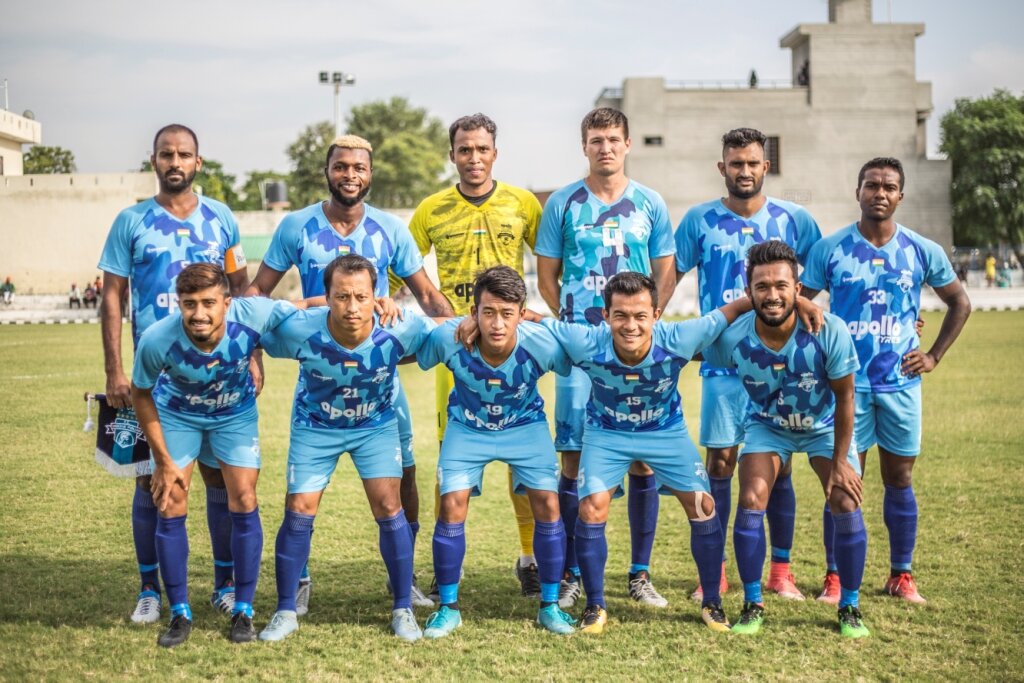
Now, two teams claim the Punjab FC Legacy, Minerva Academy and Roundglass Punjab FC. The first is Bajaj-ji’s project, still aiming for a Cup challenger in a little more than a decade. The second bears the name of Gupreet Singh’s business. Roundglass aims to support wellness for all through data and health programs. Hence the combination of training, teaching, and building a top tier club.

Roundglass will play in the I-League next year while Minerva stays focused on training. Time will tell how teams evolve from here, but both share a valuable vision.

How are we Punjab FC

One thing I hope you boys learn from me, that I learned from both Montana and Punjab, is to respect how what you have, largely depends on what others before you have done.

It reminds me a lot of what former President Obama said almost a decade ago. “Somebody helped create this unbelievable [system]…that helped you succeed.”

Your grandpa Mark started a business that has grown and grown. But he didn’t pave the road to work, he didn’t teach his employees their ABCs and 123s, he didn’t build each part and make every sale, he had a team. The business’ success isn’t just his it’s theirs, and all the people who helped them along the way.

I teach kids, but I don’t feed them before school or limit their screen time to complete it at home. Your mom markets classical music but she doesn’t play the cello or rig the lighting.

When Punjab FC takes the pitch this year, it won’t be Ranjit or Gupreet’s team, it won’t be the managers’ or the players’ or the fans’. It will be a shared experience. As President Obama’s rival, Governor/Senator Mitt Romney, once said

“you didn’t get here solely on your own power. For most of you, loving parents, sisters or brothers, encouraged your hopes, coaches guided, communities built venues in order to organize competitions. All Olympians stand on the shoulders of those who lifted them.”
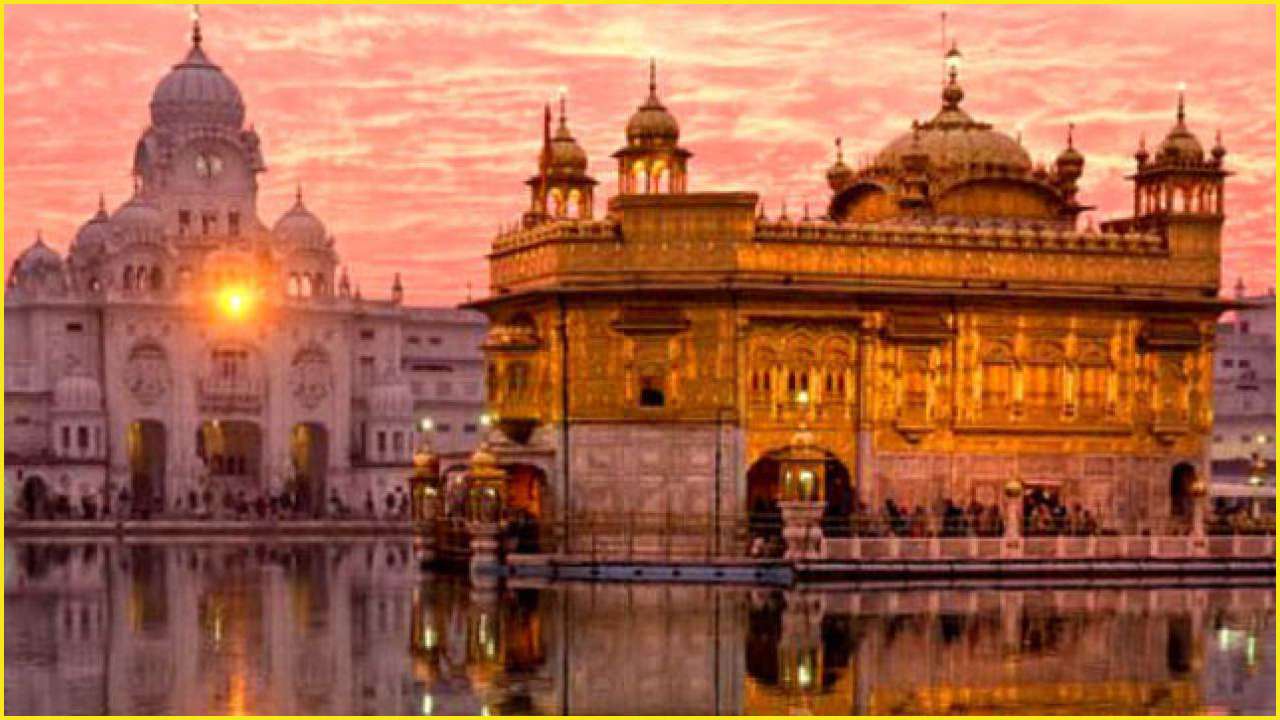
The Golden Temple’s Golden Hour

Punjab as a place thrives because people care for others. Every farm, every temple, every shop, every football club succeeds because others strive to succeed. Roundglass is indebted to Minerva, and Minerva to Roundglass. They share the privilege and the power of Punjab FC.

You are indebted to your mother and me, and our parents, and our friends, and your teachers, and the random kindness of Punjabi families who offered support and food and shelter.

What we build, we build with others.

47. Face the Future

47. Face the Future

It struck me that I ought to explain a little bit about why we cheer for the teams we do. Well, in part, it’s because I thought we ought to, and I’m the one of us most capable of complex thought and logic. But also, each team has a special something that captures part of what I love about life, and part of what makes you who you are.

So periodically (like during international breaks, long summer holidays, or say, global pandemics that completely alter everything we understand about our lives and ourselves), I want to introduce you to the teams we are tied to.

Our tenth team to meet is a team that embodies the hope and optimism in a new vision of the future, Ghana’s Legon Cities FC.

Dear Boys,

Wherefore Legon?

Across the Atlantic, there’s hope and opportunity. That’s what your European relatives thought before they left Scotland, Norway, Serbia, and Germany (via Russia) to come to the United States.

They had hope because others were taken and brought across the same water without hope. Our opportunities were paid for, in part, with the blood and pain of others from Africa.

Centuries later, we can find opportunities for both ourselves and some of those most harmed by slavery. Africa is a continent of hope. Ghana is a country of invention and imagination. Legon is a city where the future comes to be real.

I studied in Legon during college. I made new and vital friends, read a lot of great literature, studied with excellent professors and poets, and taught amazing students. I enjoyed it so much, I did it again 5 years later. Legon is a special place. It is the future of a growing nation, and will help shape the future of our changing world.

Who is Legon Cities?

Legon Cities bringing the flash

A few years ago Ghanaian football was in trouble. Leaders in the country shamelessly solicited bribes. The league was plagued with allegations of cheating. And money for investment was scarce.

Enter Richard K. Atikpo. A well heeled oil tycoon, he swooped in to buy Wa All Stars, a northern team whose prior owner was in a heap of trouble, and move them to the Accra area, rebranding them Legon Cities.

In doing so he sought to build and brand a new kind of team in Ghanaian football. A team with as much flash and flair as a rock concert and as much ambition as the biggest sides in the game.

How are we Legon Cities?

It’s not that we have flash and flair. It’s not that we’re changing the game. But when the future comes to bear, Legon Cities is a symbol of what we aspire to do.

Heading into our future

When you have to face the future, approach it as an opportunity to seize not a challenge to be feared.

Ghana is going to shape the coming century. All of Africa will too. Our countries will become more diverse, more connected with the wider world. When they do, we ought to be Legon Cities. Accept the change and make the most of it.

We can say that we’ve backed Legon Cities from their start, even though that start was just a year ago. They’ll be near the future of football. I hope we are near the future of our world too.

38. Savor Your Own Style

38. Savor Your Own Style

It struck me that I ought to explain a little bit about why we cheer for the teams we do. Well, in part, it’s because I thought we ought to, and I’m the one of us most capable of complex thought and logic. But also, each team has a special something that captures part of what I love about life, and part of what makes you who you are.

So periodically (like during international breaks, long summer holidays, or say, global pandemics that completely alter everything we understand about our lives and ourselves), I want to introduce you to the teams we are tied to.

Our ninth team to meet is a team that continues their race to redemption: Alebrijes de Oaxaca a team that takes pride in their style

Dear Boys,

Wherefore Oaxaca?

Far to our south, beyond the beginnings of Mexico, there’s the southern region of Oaxaca. It’s an area that has been settled for tens of thousands of years, long before there was a Mexico, long before there was soccer, long before there was even a Spanish or English language to give us those words.

As with Emelec, we owe our allegiance to Oaxaca less to what we know and more to who we know. Strangely, a large crew of immigrants from the southern coast have settled in the frigid north. I’ve worked with many, taught with more, and sincerely appreciated all that they bring to our community.

Who is Alebrijes de Oaxaca?

One of the youngest teams in our group, Oaxaca owes it’s existence to the struggles of another. Tecamachalco, just to the north of Oaxaca had earned promotion, but they had run out of funds. Worse, they couldn’t move up without a stadium to suit their needs.

That’s where the Oaxacan government and local businessmen stepped in. They brought the team south, financed a beautiful new field and led the team to rebrand as Alebrijes de Oaxaca. When I say rebrand, I mean rebrand. Gone are the simple colors, and the basic kits in are the bright local colors and the vivid local uniforms.

They haven’t been around for long, but with one title already in the bag, they are ready and eager to break the longstanding northern vice grip on Mexican soccer.

How are we Oaxaca?

I will make no pretenses to be stylish. I’ve been accused by more than a few students of dressing like I wanna be a banker. I know that I’ll never be mistaken for a fashion plate or a model, but the truth is, I’m fine with that. I have my style, and frankly I like it.

That’s all that matters really. Don’t worry what your style should be, enjoy what your style is.

That’s what Alebrijes de Oaxaca offers that again and again. The mascot, the Alebrijes, is a vivid embodiment of local folklore. And a name chosen by the fans. The kits are a riotous combination of colors and patterns that match the local artifacts and fervor.

Oaxaca is boldly, proudly, absolutely true to themselves. The name, the kit, the stadium, all of them are part of the local style and scene. You don’t have to adopt their style, frankly I think they’d hate that. But please, be like Oaxaca, enjoy your style, whatever it may be.

34. Never alone

34. Never alone

It struck me that I ought to explain a little bit about why we cheer for the teams we do. Well, in part, it’s because I thought we ought to, and I’m the one of us most capable of complex thought and logic. But also, each team has a special something that captures part of what I love about life, and part of what makes you who you are.

So periodically (like during international breaks, long summer holidays, or say, global pandemics that completely alter everything we understand about our lives and ourselves), I want to introduce you to the teams we are tied to.

Our eighth team to meet is a team that kicks off their new season this weekend: Grenoble Foot 38 a team that shows us how loyalty pays off.

Dear Boys,

Wherefore Grenoble Foot 38?

In the French Alps, there’s a mountain town with a long history of sport. Grenoble has hosted the Winter Olympics, a strong rugby side, and, for over a hundred years a football team.

We aren’t French. Your grandmother wanted to be a French teacher. Your uncles and I still occasionally drop into French when we want to speak without others knowing what we’re saying. But we have as much claim to French culture or heritage as “French Fried Twinkies”.

But Grenoble is special. It’s where I got my first taste of independent living, and my first appreciation of how to do it well.

Who is Grenoble Foot 38?

The Grenoble team we see now is not the Grenoble team of 1892, or 1938, or even 2000 when I knew it.

For as beautiful as football is, for as magical and human as it can be, it is also a business. And though Grenoble is big for its region, it’s not exactly a focal point in French life, so making money on football in Grenoble wasn’t easy. That’s why teams changed, merged, folded, reformed and survived throughout the 20th Century.

Grenoble’s Stade Des Alpes

That is, until a company called “Index Holdings” arrived from Japan to buy the club and build it into a force. In four years, they moved the team up to the top tier of French football, only to crash back down soon after.

Why did they crash? Simple. They didn’t have the money to pay the players or rent the stadium. “Index Holdings” claimed to make a net profit of 204 Million Yen. In reality, they had a net loss of 605 Million yen. 800 Million off. An 800 million yen lie. I know you’re young, so let’s just put it like this. Their mistake would be like me claiming to have a box of Bunny Graham crackers for your snack, only instead of having a box of Bunny Grahams I had 3 pieces of paper that said “box of Bunny Grahams” on them.

Naturally, without that money, Grenoble couldn’t keep playing at the top league, or the next league, instead they plummeted to the fifth level of French football. Despite a sparkly stadium and high expectations, the team was back to basics. It has taken them nine years to be stable and steady in the second division, back where they were when I first met them.

How are we Grenoble Foot 38?

Like I said, Grenoble was where I first had to live independently. Why? Well, at 17 I went on a study abroad trip to France with my high school friends. After a few weeks of touring, we got off a bus in the village of Annecy and met our host families. Except for me. Mine wasn’t there. Mine wasn’t even in Annecy. I was driven to a meet up somewhere in the country side, put into another car and driven off to the distant city of Grenoble. I was 100 kilometres from my classmates, my teachers, and anyone who knew me.

I was also a massive disappointment to my host family. I spoke enough French to get by, but I wasn’t cool, or cosmopolitan, or full of American bravado. I was a nerdy, skinny little kid from rural Montana, and my super-cool host sister Natalie was stuck with me for a week. The saving grace was that Natalie was dating a guy at the local football academy. We would lie around the flat watching MTV in the morning, eat macaroni and a Cornetto for lunch, then go to the academy to meet her boyfriend, Sebastian, and all of his mates (Mehdi and Mohamadou appear in my journal at the time) before going shopping or swimming or just to hang out in the afternoon.

By the third day the guys had decided I was no threat. I was nice enough, trying my best, and definitely neither strong enough nor handsome enough to steal away a girlfriend. I had decided that they were the kinds of friends I would like to have. Reliable, supportive, and fierce.

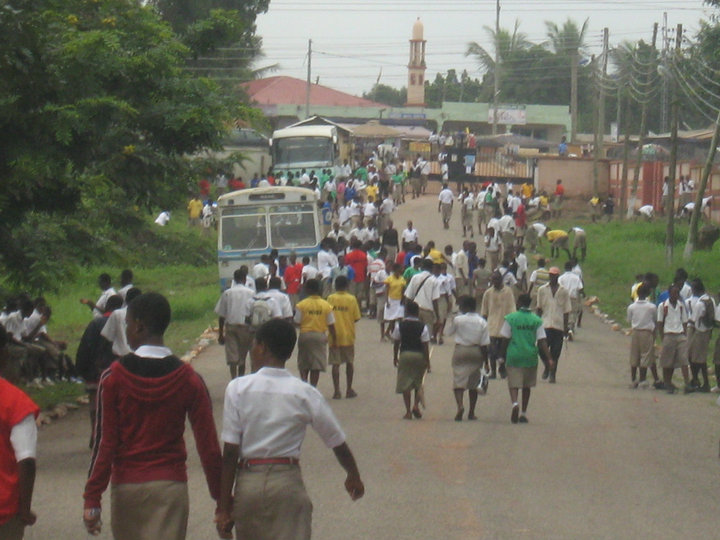
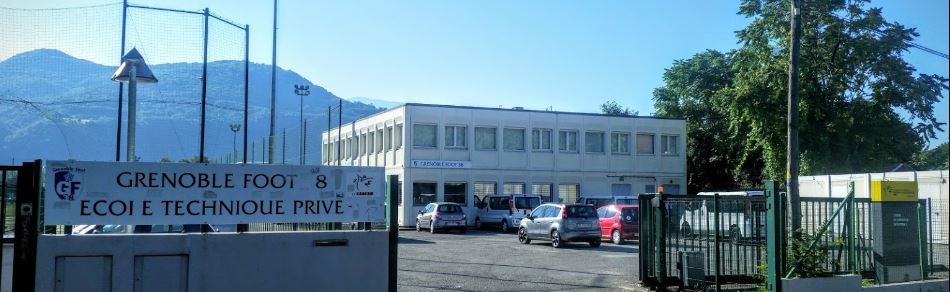
The School/System my new friends used

Two nights before I left, we went to a house party in a small suburb. We didn’t stay there long before some local French guys began to harangue our assembled gathering. Our crew was, to a person, an immigrant, or the child of an immigrant. West African, North African, Lebanese, Italian, Spanish, Chinese, Romanian, and me, a bewildered American. The French guys wanted to fight, and this crew of friends stood shoulder to shoulder on picturesque cobblestone streets, jostling and jawing at each other.

I never threw a punch. I don’t think any one did. But when it was over and we walked back to the house at 2 AM I thought: you are never alone in the world if you have people you can rely on.

That’s what Grenoble Foot means to me. When I was alone, young men who trained to join the team, made sure I had someone to rely on. When they were targeted, they made sure everyone in the group had someone else to rely on, and I hope I was part of that.

Grenoble Foot 38 wasn’t alone when they found out their owners didn’t have two yen to rub together, let alone 200 million. They had their community, their staff, their players, and their fans. I’m there for them, because they were there for me.

20. Maybe, You’re Going to be the One Who Saves Me

20. Maybe, You’re Going to be the One Who Saves Me

It struck me that I ought to explain a little bit about why we cheer for the teams we do. Well, in part, it’s because I thought we ought to, and I’m the one of us most capable of complex thought and logic. But also, each team has a special something that captures part of what I love about life, and part of what makes you who you are.

So periodically (like during international breaks, long summer holidays, or say, global pandemics that completely alter everything we understand about our lives and ourselves), I want to introduce you to the teams we are tied to.

Our sixth team to meet: Minnesota United FC in St. Paul (your home town). A team that captures better than any other how community supports sports like sports supports a community

Dear Boys,

Wherefore Minnesota United?

This one is pretty easy. You know that big silver structure we go past on the way to grandma and grandpa’s? That’s Minnesota United.

You know those black and blue shirts and scarves and hats your dad and mom wear and share with you? That’s Minnesota United.

You know the chants I teach you? The walks in summer sun to hear drums, to Shout “Go Loons”? to Eat pizza, and donuts, and curry? That’s Minnesota United.

The first five teams tie to part of our family’s past. The next five all relate to our community’s future. Minnesota United is our present, our here and now, our neighbors, our local team.

Who is Minnesota United?

There has been professional soccer in Minnesota since 1976. The names, colors, owners, stadia, and leagues have changed a lot in that time. But the fans have kept it going throughout.

The team badge

This particular side dates back to 2009 when one fore-bearer, Minnesota Thunder, ceased operating. by the grace of a new minor league a team was kept alive. Not just alive but thriving. The NSC Stars won one title and finished second for another before a new owner stepped up and made the team Minnesota United, complete with the red eyed “Deathloon” crest.

Every part of our local soccer history is a story of, as Tom Stoppard might say “insurmountable obstacles on the road to imminent disaster”. Luckily enough it all works out well in the end because of one simple thing.

How are we Minnesota United?

We are stronger together than we could ever be alone.

Soccer teams in America rise and fall like the stock market. The highs are thrilling and rewarding. The lows often include a sense of overwhelming despair and (often) abandonment.

We love the Loons, but they could have gone the same way as the Baltimore Bays, Tampa Bay Mutiny, or San Francisco Deltas. There’s only one thing that makes Minnesota United one of our teams rather than a wistful footnote of what might have been: a community that pushed on while the teams faltered.

As valuable as a team is, it’s nothing next to the community that unites behind the team. Lots of teams have supporters and fans, but that can’t replace a lack of financial support. Lots of teams can find a backer, but that doesn’t mean much if you alienate fans. It takes a whole club–players, coaches, owners, and fans–to make it work. And that’s what makes Minnesota United our team, we are part of the community that built and sustains it.

One of the team’s legends goes that when the money was tight and the future was unsure some players started singing “Wonderwall” by Oasis to celebrate wins. Then the players sang it to the fans in gratitude for loyalty throughout the season. Then the fans sang it back. Then the new owner felt inspired to join the team. And Minnesota United went from being “the team no one wanted” to being a team saved by everyone around it.

“Maybe you’re going to be the one who saves me

Cause after all

You’re my wonder wall”

Oasis
19. A fire in their heart, a light in their eyes.

19. A fire in their heart, a light in their eyes.

It struck me that I ought to explain a little bit about why we cheer for the teams we do. Well, in part, it’s because I thought we ought to, and I’m the one of us most capable of complex thought and logic. But also, each team has a special something that captures part of what I love about life, and part of what makes you who you are.

So periodically (like during international breaks, long summer holidays, or say, global pandemics that completely alter everything we understand about our lives and ourselves), I want to introduce you to the teams we are tied to.

Our fifth team to meet: The University of Montana Grizzlies in Missoula, Montana. A team that captures what I learned best from growing up in Big Sky Country

Wherefore The Montana Grizzlies?

Dear Boys,

If the first four teams are your ancestor clubs, the University of Montana is one of your immediate family teams.

I was born and raised in the big MT. Your mother visited almost every year as a kid. Our family ties back to Red Lodge and Billings in the southeast, to Libby in the northwest, to Great Falls in the smack dab center.

Your great grandparents soda beverage company (sorry about the appropriation)

But we also tie back to the University of Montana in Missoula. Your grandma Di got her BA, and your grandpa Bruce got his JD from the U of M. Even after decades away, your mom and I love to go home. Missoula offers those quintessential Montana scenes: the purple mountains majesty, the rolling rivers, and more hiking trails than you can shake a walking stick at.

Because our story is so immediately, personally tied to Montana, we needed a team from the Last Best Place on Earth. And there’s no better team than the Griz.

Who are the Grizzlies?

While the University of Montana has been educating young minds for well over a century, the women’s soccer team is just over 25 years old.

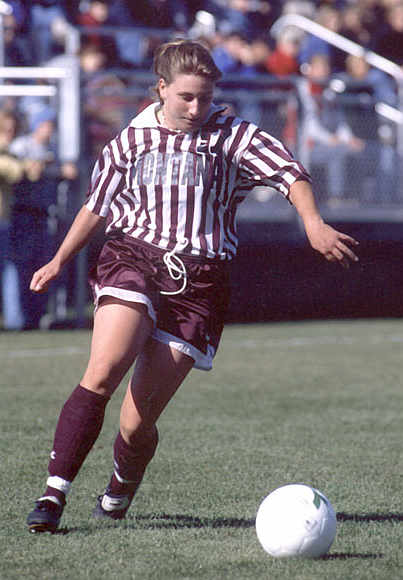
Karen Hardy of the early Grizzlies sides
(UM Sports Info)

Started back in 1994 (the same year I fell hard for soccer 166 miles to the north east-ish), the Women’s soccer team has featured tremendous and talented athletes from home and beyond. They’ve won the regular season title seven times, and won the conference tournament five more.

Because the team is still young (especially compared to the century old sides we’ve been talking about), they’re still building an ethos and a legacy. But under all four coaches (including Mark Plakorus who used to coach your uncle Matt, and Chris Citowiki who used to coach down the street from us at St. Kate’s): culture, community, and academics are all emphasized. During these odd times, the Griz have often found ways to celebrate each other and have fun, even at a distance.

One of my favorite things about sports here in the US is how, when it’s done well, it puts sports in its proper context. Much as I love it, watch it, write and read about it, it is still a group of people playing a children’s game. When done well, the game, the team, the experience, teach you about how to live and work just as much as they entertain or amuse.

How are we the Grizzlies?

There’s something special about pursuing what you love even when it’s not as popular or common place. A fire in your heart to sing, or code computers, or play soccer, even when ways to do it are scarce and public support is minimal.

South Campus Stadium with a view of Mount Sentinel
(UM Sports Info)

There’s also something special about clear-eyed appreciation for what things are and what you want things to be. To get that more important than winning or losing games, more than making money, getting a job, or earning the praise of others: what matters is how you do something, and who you do it with.

The Griz have, in 25 years, built a regional power in a place where kids like me heard the sport derided and diminished in very ugly terms. They’ve done it with coaches, kids, and fans from the state-wide community who are passionate about the game and focused on the family and character that comes from a good team.

Part of me wishes you could grow up in Montana, like I did. But that’s not possible. Times have changed, Montana has changed, and you (mercifully) are not me. But I still hope you’re raised with that Montana spirit as reflected by the Griz.

To paraphrase a John Denver song about my home state:

Oh Montana, give this child a home

Give ’em the love of a good family and a true love of their own

Give ’em a fire in their heart

Give ’em a light in their eyes

Give ’em the wild wind for a brother in the wild Montana skies.

John Denver, “Wild Montana Skies”

I hope you grow up with that fire in your heart, and that light in your eyes. I hope you grow up to be Grizzlies.

17. Curiosity Culture

17. Curiosity Culture

It struck me that I ought to explain a little bit about why we cheer for the teams we do. Well, in part, it’s because I thought we ought to, and I’m the one of us most capable of complex thought and logic. But also, each team has a special something that captures part of what I love about life, and part of what makes you who you are.

So periodically (like during international breaks, long summer holidays, or say, global pandemics that completely alter everything we understand about our lives and ourselves), I want to introduce you to the teams we are tied to.

Our fourth team to meet: SC Freiburg from Freiburg, Germany. A team that offers a reminder that as we move, we grow.

Dear Boys,

Wherefore Freiburg?

This is the last of the family heritage clubs in our collection. From your mom comes Vozdovak, from your dad comes Ross County, from the both of us come Rosenborg, and from goodness knows where comes Frieburg.

A few favorite Germans

I mean that quite literally. It’s not entirely clear who in the family was really from Germany, and who was descended from Germans who had stopped elsewhere first.

Your grandma Di can tie her family back to a region of Europe that straddles eastern France and south western Germany. That strand of your DNA ran off to a tiny farm village in the wilds of Russia, and then beyond, and beyond, and beyond until they got to Billings.

Other family members speak German as a tradition from someone we’ve all forgotten. We sing it, study it, read it. In short: we know we’re a little bit German, but not sure exactly how much or what that means.

Who is Freiburg?

In choosing a team to represent your German heritage I hoped to find a side with a bit of pride and a lot of curiosity: I found SC Frieburg.

SC Freiburg is by no means the most renowned club in the Bundesliga, for a long time they weren’t even the most renowned club in Freiburg. But they are undoubtedly, special.

They absolutely question habits, as you’d expect from a University town with liberal ideals and an intelligent culture. Freiburg’s manager often eschews tactics in meetings and interviews in favor of sharing views about world events and the prejudices that diminish our world. (A habit shared by the team’s fans)

Freiburg loves its surroundings, and welcomes others from around the world. There’s a love for the foreign flair of their club not the stubborn “Deutschland-Uber-Alles” attitude that makes some foreign born Germans a little leery of their homeland. Freiburg’s crew includes French, Italian, English, Australian and even Korean players. They’re most cherished nickname is “Breisgau-Brasilianer” because it suggests a blend of Brazilian style with their neck of the woods. (Even the club crest is about blending: why be lions or eagles, when you can be a griffin and be BOTH Lions AND Eagles!!)

In all the club is welcoming, curious, and proud of their way of doing things. I’ll let them say it themselves:

“in Freiburg, football isn’t a way to release your frustrations – here it brings about a sense of joy. In this way, it is something for everyone in the region to enjoy, just like the wonderful landscape, delicious food and good wine also is.”

SC Freiburg Team Website

How are we Freiburg?

In short, Freiburg is at least close to your Germanic home land, but they also are the kind of open-minded, optimistic organization your family loves. SC Freiburg knows that a curious culture and a changing culture is the strongest.

Manager Christian Streich at the end of his commute

Whomever your German ancestors were, they weren’t tied to one way of doing things. Whatever their goals in leaving home, they were open to not just moving, but moving again, and again, and again. They passed on a love of family, but not a love of habit. They encouraged an attitude of engagement with others not isolation.

Yes, we have a family bond with Germany. We’re not sure what it is, why it’s there or what it means, but we’re curious and interested in finding out more.

SC Freiburg has a soccer team. They love it, but they know that doesn’t mean that it will triumph, or dominate. Frankly, that’s fine. They’re open to growing with each generation of players that comes along, each question that’s asked, each managerial lecture about everything but tactics, and each fan who feels the love of the game.

At a time when many people would rather wrap themselves up in familiarity than risk the unknown and possibly unpleasant, I hope you take the SC Freiburg mentality, and keep curiosity in your mind and change in your heart.

16. MacKenzies and Ross County Loyal to Rebellion

16. MacKenzies and Ross County Loyal to Rebellion

It struck me that I ought to explain a little bit about why we cheer for the teams we do. Well, in part, it’s because I thought we ought to, and I’m the one of us most capable of complex thought and logic. But also, each team has a special something that captures part of what I love about life, and part of what makes you who you are.

So periodically (like during international breaks, long summer holidays, or say, global pandemics that completely alter everything we understand about our lives and ourselves), I want to introduce you to the teams we are tied to.

Our third team to meet: Ross County FC from Dingwall, Scotland, a team that reminds us about loyalty.

Dear Boys,

You should know your name. Not just what it is, but where it comes from, and what it means.

Wherefore Ross County?

Your names come from a long line of Scottish ancestry. Alexander and Owen both have long legacies in Scottish culture. Alexander means defender of the people; Owen, “young warrior”. But those are your names, and you can make them your own. MacKenzie is the one we share, with each other, with a host of blood relatives and an even bigger pile of MacKenzies around the world. But almost all of us tie back to Eastern Scotland, Ross-shire, and it’s seat Dingwall.

The legend goes that the MacKenzies rose to the rank of a noble clan because of the actions of one Colin Fitzgerald who probably just helped fight off invading Norwegians in the late 13th century. More romantically, he saved King Alexander III from being killed by a stag (told you we’d meet a Scottish Alex). There’s even a beautiful painting to capture it.

Great x 25 Grand-uncle Colin saving Alexander III from a stag.
By Benjamin West, displayed in the Scottish National Gallery

For his bravery, Colin was awarded a big swathe of land including Ross-shire, and Cromarty. He also earned the clan crest with a stag smack dab in the middle. From then on the clan was a political and social force, commanding armies, navies, and hosts of others loyal to the Caber Feidh (Chief). The name MacKenzie has a lot of history and power behind it. And the Caber Feidh is a worthy leader and nobleman.

To be clear, we’re not noble.

If we ever were noble, a long, long line of second, third, and fourth sons have put you so far behind the line of succession it would take a very specific catastrophe to put any of us in line to inherit a castle.

We are descendants of a MacKenzie who wasn’t going to inherit the farm in Ross-shire, so he left to become a tailor in the colonies. Still, he was a MacKenzie. His children were MacKenzies and so on down the line to your grandpa, to me, and to you.

Who is Ross County?

MacKenzies are loyal, often to the point of stubbornness. We are promoters of lost causes and noble failures.

MacKenzies stood up to the hated English rulers far more often than was wise. They often felt that the throne in London ought to be held by a Scotsman (or woman). As the Queen is still as English as Earl Grey tea and Blood Pudding, you should know: we lost. Frequently.

So we may not be loyal to a particular ruler, but we are loyal to our family and our beliefs. We may not be great winners, but we are reliably present. Ross County FC isn’t just close to home, it doesn’t just have the family stag on their team badge, but they embody loyalty and question what it is to lose.

The Staggies trace their history back to 1929, around the time your Great-Grandpa MacK was 8 and part of the long ago Americanized MacKenzies.

At the time, Ross County had no glorious honors, or even pretenses of power to be claimed. They had neither the talent pool of Rangers or Celtic in Glasgow nor the resources of Hibs and Hearts in Edinburgh. They had each other. The Staggies were a host of local boys, playing their best. Their best years gave them little more than bragging rights over local rivals.

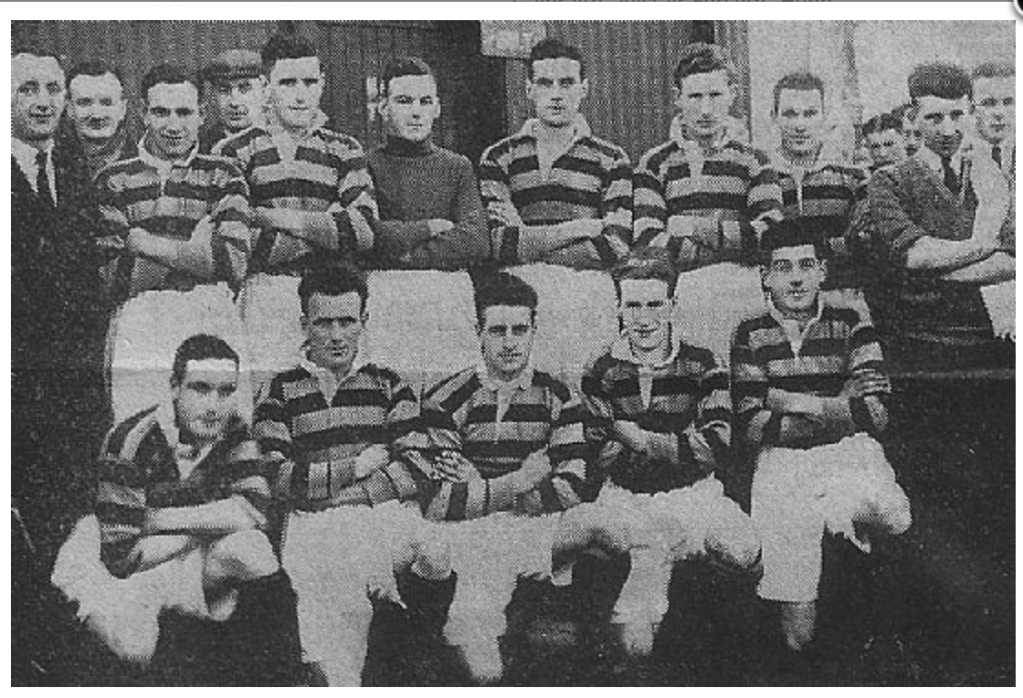
Photo from the online collection of Roy Bremner
Ross County’s first Scottish Cup Game in 1934
In the middle of the front row is W. McKenzie

It took nearly 40 years to win the local Highland League, and nearly 25 more to win it a second time. Only then did they begin to plan in earnest to join the elite sides of Scottish soccer under the chairmanship of Roy McGregor.

Since 1992, Ross County has steadily risen to become a reliable side in the top Scottish League. That’s thirty years to go from the local lads of Dingwall to one of the ten best teams in the land.

How are we Ross County?

Of course in Scotland, where two teams thoroughly dominate the league, being in the top ten doesn’t come with oodles of glitz or glamour.

It would be easy to cheer on Rangers or Celtic and trust that a trophy or two would be won each and every year. But it wouldn’t be very MacKenzie.

Ross County Supporters in full throat

We’re a family that never met a rebellion we didn’t like. That first American MacKenzie? His first tailor job was sewing for the colonial army. We are still more loyal to causes we believe in than we are strategic alliances for power. For proof, think of your grandpa who campaigned for Democrats who never had a prayer in deeply Republican Montana.

Lots of teams can remind you about loyalty, but Ross County reminds us that what you are loyal to is more important than being loyal itself. For us it’s a local-family style club in an age of flashy corporate giants. It’s a rebelliously modest team with minimal title pretentious in an age of win-now overreactions.

We are Ross County because we’re not just loyal to our clan, we’re loyal to what that clan stands for.

14. On Love and Change

14. On Love and Change

It struck me that I ought to explain a little bit about why we cheer for the teams we do. Well, in part, it’s because I thought we ought to, and I’m the one of us most capable of complex thought and logic. But also, each team has a special something that captures part of what I love about life, and part of what makes you who you are.

So periodically (like during international breaks, long summer holidays, or say, global pandemics that completely alter everything we understand about our lives and ourselves), I want to introduce you to the teams we are tied to.

Our second team to meet: FK Vozdovac from Belgrade, Serbia. A team that reflects how we love our family.

Dear Boys,

Wherefore FK Vozdovac?

You should know that you boys are deeply loved.

Not just by your parents (obviously), or your grandparents (certainly), or your uncles and aunties both of blood and affinity. You are deeply loved by people half a world away who have never met you.

Gozpic in Winter

You are loved by your Grandma Di’s cousins Mariana and Dragana in Serbia. Their grandparents were related to your grandma’s grandparents (your great-great grandparents). Great-great grandfather Mane and Great-great grandmother Sofia Dimich left Gozpic in the Lika Valley for America and (eventually) Red Lodge, Montana.

Your great-greats were Serbs before there was a Serbia. Before the Lika Valley and Gozpic were part of Croatia, or all of these kingdoms and places were part of Yugoslavia. They were people who started over on a new and different frontier, while kept the old ways and old family close to heart. So while the family is built on love, the truth is changeable.

Mariana and Dragana don’t live in Gozpic, or the Lika Valley, they live in Belgrade. They live among no fewer than 8 local clubs in one of the most feverish hotbeds of soccer in the entire world. Some are casual. Some are legendary. For you I chose FK Vazdovac.

FK Vozdovac

Who are FK Vozdovac?

FK Vazdovac are neither a legendary Serbian side, nor are they a casual crew of weekend warriors.

“Master Daca” with a great mustache

One of the oldest clubs in Serbia, Vozdovac can trace it’s origins back to 1912: two years after your Great-Great Grandpa Dimich headed west and two years before Sofia joined him. Its one of four clubs founded, in part, by Danilo Stojanovic. The forefather of Serbian soccer ran clubs, managed teams, and even played a rather adept goalkeeper from time to time.

The Old Vozdovac Stadium

For the next century, the team bounced around lower levels of Serbian, Belgrade, and Yugoslavian leagues. It would combine and merge with several other neighborhood sides when times were tough, but results never matched their more prolific neighbors: Partizan Belgrade and Red Star Belgrade.

It was only in the early 2010s that Vozdovac became a fixture in the top tier of Serbian football. This at the same time Serbian football began to face a serious split between how much of the games were organized for the owners, and how much for the Ultra Supporters.

The New Vozdovac Stadium

Vozdovac’s new owners helped them leave behind a tiny ramshackle field, for a rooftop arena perched above a lucrative shopping complex. Their money and vision helped the team remain stable and improve their performances.

But that doesn’t mean the fans are thrilled. After all, it’s not all about the winning, and many Vozdovac fans loved the club wherever they played and however they fare. The new ownership seemed to abandon long standing traditions and stadia which smacked of disrespect to the fans. Fan support in Serbia is much more about the community than the club, sometimes to the good, and sometimes to the terrible.

The past twenty years has seen a long, long, long, long, LONG stretch of ugly events around Ultra Supporters Clubs in Serbia, especially in Belgrade (whose largest clubs Partizan and Red Star, offer the fiercest groups: The Gravediggers and the Heroes).

Some groups provided recruits for the late 1990s Bosnian genocide, others for gang violence and illicit drug deals. Some engage in grim racist attacks, others in gross assaults of opposing fans and police. Through it all there’s an ugly strain of white nationalism, neo-nazism, and criminality broadly tolerated by the government because these supporters also crack down on protesters.

How are we FK Vozdovac?

I couldn’t ignore your Serbian heritage. I can’t forget that your uncles and I had a host of Balkan coaches and classmates in Montana who taught us to love the game, our teammates, and opponents. I can’t gloss over the tremendous pride in Serbian heritage that comes out in your Grandma and her family. I won’t insult the love that Mariana and Dragana show you by inviting you to love the whole wide world of football…except their country.

But I can’t talk about the beliefs and values we hold and blithely tolerate or ignore the Ultras that make football in Belgrade so bloody and bitter.

Choosing a team meant eliminating Partizan and Red Star straight away. The rest of the Serbian leagues can’t compete with those two teams’ trophies or their rap sheets. I looked at some other teams, but FK Vozdovac stood out early because of their unique stadium and the dragon badge I thought was a great reflection of your mother’s love of dragons. (For the record “Dragana” comes from the word for precious or dear, but the word play is nice to have.)

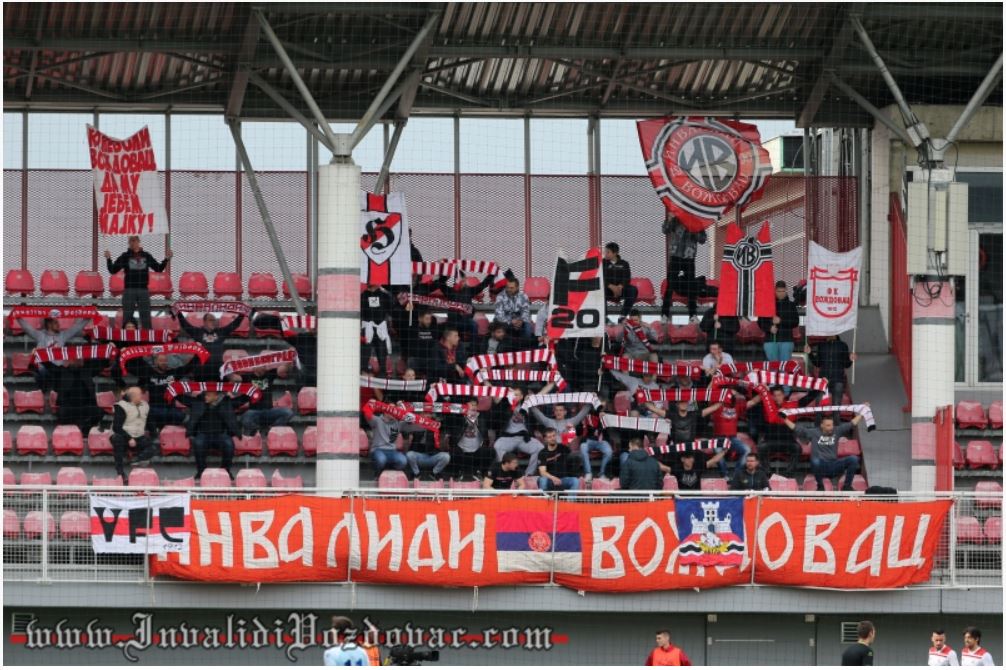
The Invalids

Still, like seemingly all teams, Vozdovac has an Ultras group with a little more love of violence and fascist imagery than I’m comfortable with. They call themselves Invalids (far less fierce or grim than “Heroes” or “Gravediggers”), but they still encourage a fight with the police and revel in sexist chants. They loathe the club owners, but the team owners completely accept their behavior, using the Ultra’s own language to describe fans on the official team page.*

So why stand alongside “The Invalids”?

I think we should be fans of Vozdovac because it offers a strong symbol of the kind of love for family I hope you grow into. Proud regardless of the trophies. Strong and precious as a dragon, but not blind to the problems we have. Above all, like your Great-Great Grandparents, like your Grandma, your Mother, and your Aunties around the world: lead with love and be willing to change.

Football in Serbia can be an ugly thing. If we choose to ignore it, it stays that way. If we amplify the love we have for our history, our heritage, our values, we can make sure that the team isn’t just for the Ultras. It’s for all of us.

All of us

*(I recognize you boys won’t get this until you are much older, but the performative analysis of the group posted on their own website is fascinating…and not nearly as positive as they seem to think it is…)

13. Proud Past. Strong Future

13. Proud Past. Strong Future

It struck me that I ought to explain a little bit about why we cheer for the teams we do. Well, in part, it’s because I thought we ought to, and I’m the one of us most capable of complex thought and logic. But also, each team has a special something that captures part of what I love about life, and part of what makes you who you are.

So periodically (like during international breaks, long summer holidays, or say, global pandemics that completely alter everything we understand about our lives and ourselves), I want to introduce you to the teams we are tied to.

First up, Rosenborg BallKlub of Trondheim, Norway. A team that captures your proud past and our family’s strong future.

Dear Boys,

Wherefore Rosenborg Ballklub?

This is our Norway team.

That is no small matter, especially since you are both half Norwegian. We’ll talk more about the other parts of your heritage but the biggest identity marker is undoubtedly the Norwegian part. After all, from the top of your blondish heads, to your fjord blue eyes, to your lefsa white skin, you look Norse.

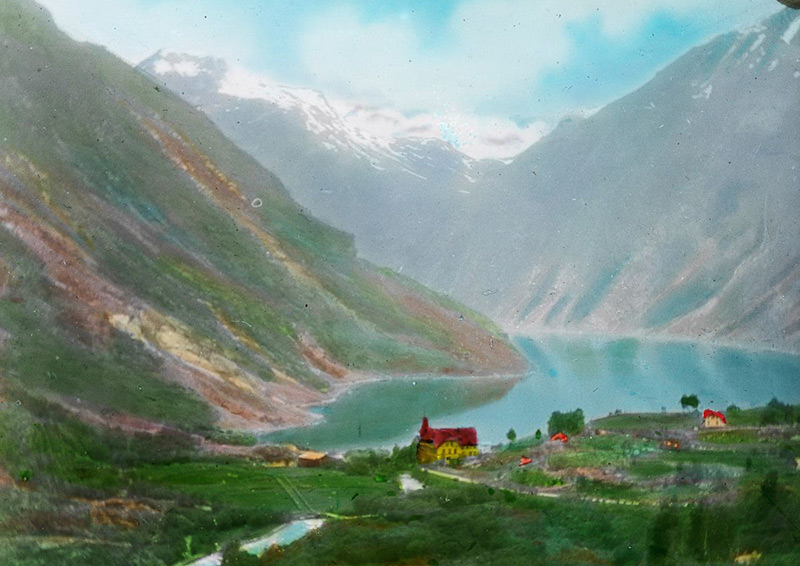
What it looked like when our ancestors left

But it goes beyond your looks. It’s in your names as well. Your mom’s maiden name, Gorder, is probably a lazy immigration agent’s interpretation of a great grandparent’s home: Gårder (farms). Owen Roe, your middle name (and mine, come to that) is a similarly lazy translations of “Røv”. The valley your great-great-great-grandparents left behind to come to Minnesota almost 170 years ago.

I find it easy to imagine your ancestors. Simple folks tired of the squeeze of crowded farm land and nosy neighbors, heading up to one of the biggest ports in the country and heading off too seek their fortunes in the new world.

Had they stopped before the boat. Had they abandoned the farm land for city living. We might have settled for decades and decades in the popular port of Trondheim. Even if they hadn’t–if they’d clung to the local land and familiar faces–it’d be hard to resist the lure of the team that defines Norwegian clubs today. And that’s where Rosenborg BK comes in.

Who is Rosenborg Ballklub?

For a team that can fairly be called the Real Madrid, the Manchester United, the New England Patriots of Norwegian soccer, Rosenborg doesn’t come from sterling silver stock.

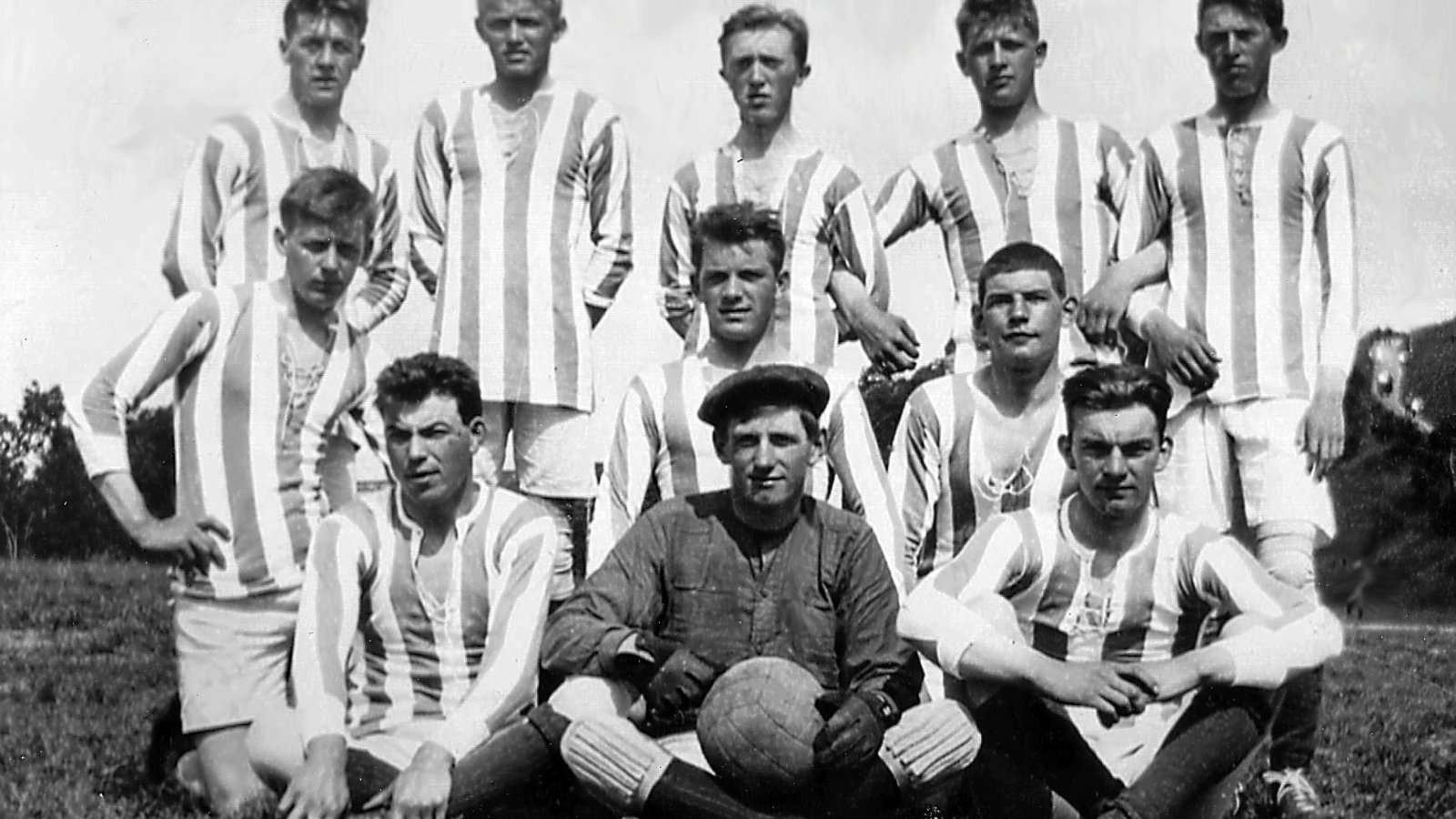
The Original Rosenborg (Nee Odd) 1917

At first they were just a few boys from a local suburb with some big dreams. How big? They named themselves “Odd” after the best team of the time. As hopeful and idealistic as when your uncles and I pretended to suit up for the Michigan Wolverines during driveway basketball.

The difference, most aspirational names remain just that: a hope, more alive in mind than in reality. Rosenborg outgrew Odd, growing more prestigious and popular in their own right. The team’s first trophy, the national cup in 1960 was won by beating Odd.

Since then the team has come to rule much of Norwegian soccer. Ruling the league table with a full decade of dominant title wins. Cruising with confidence into competition against the continent’s best teams. But in many ways, they still feel like that neighborhood gang of boys who dreamed of greatness from day 1.

How are we Rosenborg Ballklub?

To be clear, we are not Rosenborg because we are consistent champions. We are not. We do not rule. We do not dominate. We do not cruise with confidence.

Your Norwegian relatives had something else in mind, something very in keeping with Rosenborg. They had hopes more alive in their minds than in reality. They hoped to see their kids go beyond a little village. They wanted to do more than farm the same little acre of land. Not only did they succeed, they went far, far beyond it.

Historically inaccurate, but cute

One of their grandsons (your great-grand-father) not only went beyond the tiny village, he went around the world to Kolkatta and Beijing. One of their great-grand-daughters (your great-grand-mother) did much more than farm a little acre of land. She got a college degree. (She also got in trouble for sneaking back from a dance, but that’s another story.)

We are so far beyond the hopes and dreams of the Norwegian ancestors who left little farm villages, trod the streets of Trondheim and headed to the new world. We have reached greatness beyond what they might have thought or believed to be possible.

And still, we have those little glimmers of Norwegian neighborhood in our veins. It’s in the lutefisk we still make for Great-Grandpa Bud even though he isn’t here and no one else likes it. It’s in the Spritz Cookies that bring a tear to your Grandpa Mark’s eye when he makes them for you like his mother did for him, and her mother did before her.

Rosenborg BK is our Norwegian team because you are both a hope surpassed and a history alive. Our past is proud, our future is strong.